INTRODUCTION
This text was machine-transcribed from the printed book and may contain errors. Select the words and choose “Report a mistake”.
Once again, having lamented about what he is being forced to do, and not wishing to do what he is expected to do, Arjuna, like a petulant child sits down saying, ‘Govinda, I am not going to fight.’ It is as if Arjuna is waiting to be persuaded.
He is seeking an explanation. Kṛṣṇa says to him gently and smilingly, ‘While speaking learned words, you are mourning for what is not worthy of grief. Those who are wise lament neither for the living nor for the dead.’

Kṛṣṇa is more shocked than Arjuna
because He has never seen this dimension
of Arjuna—shivering, shaking! Kṛṣṇa has
never seen this powerless, weak side of
Arjuna.
See, trusting Arjuna, He went all the way as a peace ambassador to the assembly of Kauravas. The great war of Mahābhārat was the first World War because at that time, the whole of humanity, fifty-four deśas (countries) were divided into two parts. The whole world was participating.
Either you are on the side of Duryodhana, the Kaurava clan or on the side of Arjuna, the Pāṇḍava clan. And suddenly, Arjuna is saying, 'I am not waging the war!' How will you handle this? How Kṛṣṇa feels! Everyone knows Kṛṣṇa may not be in the front, but He is running the whole show, the whole war play! So, Kṛṣṇa has to solve Arjuna's problem.


YOU EXIST IN PAST, PRESENT AND FUTURE
Sañjaya says Kṛṣṇa was smiling as He uttered these words. Kṛṣṇa must have been laughing at Arjuna. ‘You fool; you pretend to be wise and quote the scriptures. Who do you think you are quoting the scriptures to? What can you understand of what I Myself have said?’
Kṛṣṇa continues: ‘Never was there a time when I did not exist, nor you and all these kings, and never in the future shall any of us cease to be.’ With this verse begins the essence of the whole Gītā. This is ātmajñāna, Self-Realization, the knowledge of completion. If you can understand this one verse, you can become enlightened straightaway and enter into eternal bliss.

You existed in the past, exist in the present and will exist in the future. Your face and body may change but you continue to exist. Then why do we think we will die and why do we fear death? If what Kṛṣṇa says is true, why are we worried about this life and about death? You need to first understand the concept of the past, present and future to enable you to understand what Kṛṣṇa says.
The past, present and future, all the three put together are eternal, Nitya or Ātman. Only when you come to the present moment do you experience Ātman— your true Self, but as of now you are constantly shuttling between the past and future. When the number of thoughts reduces, you will not even be aware of the passage of time. For example, when you are with someone you love, even two or three hours will seem like a short while. But, when you are with someone whose company is boring, even a short time seems very long.
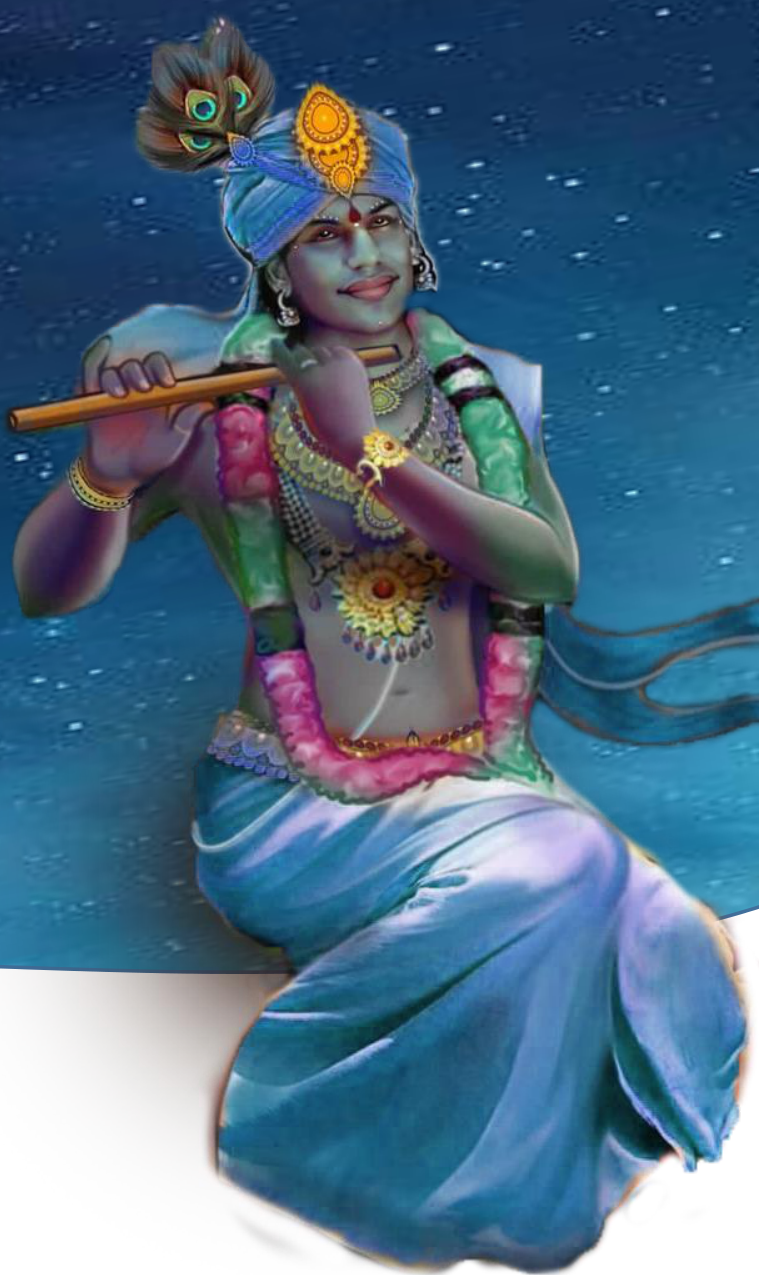
Kṛṣṇa, fully aware of Arjuna's dilemma, moves forward in his mission to destroy Arjuna's identity, the root pattern. The Guru, Master is a surgeon who removes the cancer of ego, the root thought pattern. This is what Kṛṣṇa does throughout the Gītā dialogue. To give Arjuna credit, he stays through this surgery. Many weaker men would have run away from the operation theatre, this battlefield, with no desire to let go of their identities. Arjuna's greatness lies in his integrity, his powerful determination, his decision to listen to his Master and be guided by Him.



Kṛṣṇa says beautifully, 'You
were there in the past, you are
in the present and you will be
in the future; you do not die.
You existed before birth and
will remain after death.
Whatever dies, can never live.
Whatever lives can never die.'
When Kṛṣṇa says, 'You are the
eternal soul,' He means that as a
being, you are beyond time.
COMPLETION, THE ETERNAL SPACE IN THE PRESENT
Anything which does not allow, anything which stands in between you and the present moment, acting as a barrier; which does not allow you to connect completely with life and with other people in your life in the present moment, is what is called incompletion. The gist of the second chapter, Sāṅkhya Yogaḥ is that you are the soul, that you are complete, that you are divine and that you are God. Completion is the only methodology where you can complete with your past and future incompletions. You need to know that when you do completion now, don’t think that only your future will be in completion and complete. No! Even your past gets altered. Even your past becomes complete! The moment you create the space of completion, what Kṛṣṇa declares, ‘you are the eternal soul, beyond your body and mind,’ becomes reality in your life.
GOALS:
1. Understand that the soul is eternal.
2. Understand that death is nothing to be feared.