Pratyaksha Pāda Puja
This text was machine-transcribed from the printed book and may contain errors. Select the words and choose “Report a mistake”.
॥ सद्गुरु-वन्दनम् ॥
|| sadguru-vandanam ||
The meaning of the mantra we are going to chant now is:
I surrender to that Sadguru who is the eternal bliss, the bestower of supreme happiness, the One, who is the embodiment of wisdom, who is beyond duality, who is omnipresent, to whom the Supreme goal is giving the Enlightenment experience, who is eternal, pure and unshakable, who is the silent spectator of all thought processes, who is beyond emotions and the who is without the three qualities called Sattva, Rajas and Tamas.
Now please take some flowers in your hands and close your eyes and offer the flowers at His Divine Holiness Swamiji's feet / Paduka feet at the end of the mantra.
नित्यानन्दं परमसुखदं केवलं ज्ञानमूर्तिं
द्वन्द्वातीतं गगनसदृशं तत्त्वमस्यादि-लक्ष्यम्।
© 2019 Sri Nithyananda Swami. All Rights Reserved.
एकं नित्यं विमलम् अचलं सर्वधी-साक्षि-भूतं
भावातीतं त्रिगुण-रहितं सद्गुरुं तं नमामि ॥
nityānandaṁ paramasukhadaṁ kevalaṁ jñānamūrtiṁ
dvandvātītaṁ gaganasadṛśaṁ tattvamasyādi-lakṣyam |
ekaṁ nityaṁ vimalaṁ acalaṁ sarvadhī-sākṣi-bhūtaṁ
bhāvātītaṁ triguṇa-rahitaṁ sadguruṁ taṁ namāmi ||
॥ गुरु-परम्परा वन्दनम् ॥ || guru-paramparā vandanam ||
Now please take some flowers in your hands and offer the flowers at His Divine Holiness Swamiji's feet/ Paduka at the end of the mantra.
The meaning of the mantra we are going to chant now is:
I surrender to the Lineage of all the Enlightened Masters which has Nithyanandeshwara as the beginning, Nithyanandeshwari as the middle, and my Master Nithyananda as the end.
nityānandeśvara-paramasiva-samārambhāṁ
nityānandeśvari-parāśakti-madhyamām ।
asmadācārya paryantāṁ vande guru-paramparām ।।
॥ अरुणगिरियोगिश्वर-वन्दनम् ॥ ।। aruṇagiriyogīśvara-vandanam ।।
Now please take some flowers in your hands and close your eyes and offer the flowers at His Divine Holiness Swamiji's feet/ Paduka at the end of the mantra.
The meaning of the mantra we are going to chant now is:
The Arunagiri Yogishwara who is the Lord of all beings who has the sacred musk paste applied on his forehead, who has a glittering stick, who has worn a loin cloth on His glittering hip, who has worn the Duttura flower, the king Cobra and a crescent moon on his forehead – that Arunagiri Yogishwara’s presence happens.
ललाटे त्रिपुण्ड्री निटिल-कृत कस्तूरी-तिलकः
स्फुरन्मालाधारः स्फुरित-कटि-कौपीन-वसनः ।
दधानो दुस्तारं शिरसि फणिराजं शशिकां
प्रदीपः सर्वेषाम् अरुणगिरियोगी विजयते ॥
lalāṭe tripuṇḍrī niṭila-kṛta kastūrī-tilakaḥ
sphuranmālādhāraḥ sphurita-kaṭi-kaupīna-vasanaḥ ।
dadhāno dustāraṁ śirasi phaṇirājaṁ śaśikalāṁ
pradīpaḥ sarveṣām aruṇagiriyogī vijayate ।।
॥ तत्त्वाचमनम् ॥।। tattvācamanam ।।
Achamana is the ritualistic cleansing of the mouth.
This ācamana is called tattvācamanam because the mantras used for the ācamana are the three tattvas(principles) - Ātmatattva(The principle of the soul- The individual Consciousness), Vidyatattva(The principle of the science of transcending from identifying ourselves as Jiva to Paramashiva), Shivatattva(The principle of Paramashiva - The Cosmic Consciousness)
| Keeping your right hand as in this picture, pour one uddharni of water from the Panchapatram and chanting each of the following mantra internally drink the water that flows through the base of the palm |
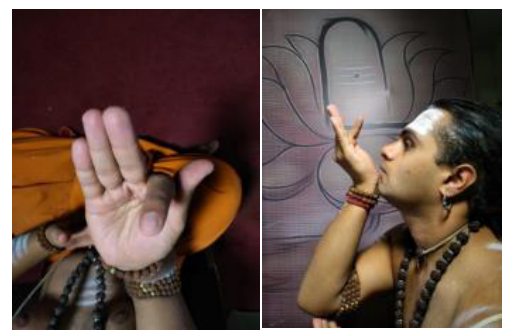
ॐ आत्मतत्त्वं शोधयामि स्वधा ।
ॐ विद्यतत्वं शोधयामि स्वधा ।
ॐ शिवतत्त्वं शोधयमि स्वधा ।
om ātmatattvam śodhayāmi svadhā |
om vidyatattvam śodhayāmi svadhā | om śivatattvam śodhayami svadhā |
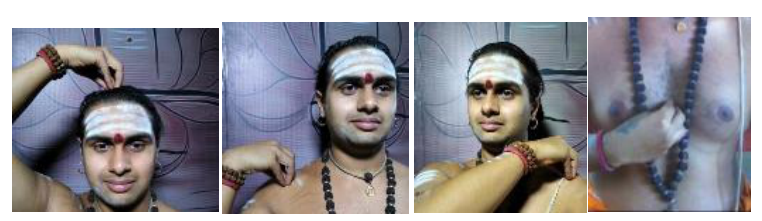
| Chanting the following mantra internally wipe the upper and lower lips twice using the base of the right hand thumb, moving the hand from right to left of the lips as illustrated in the pic ॐ हां हृदयाय नमः। om hāṁ hṛdayāya namaḥ । |
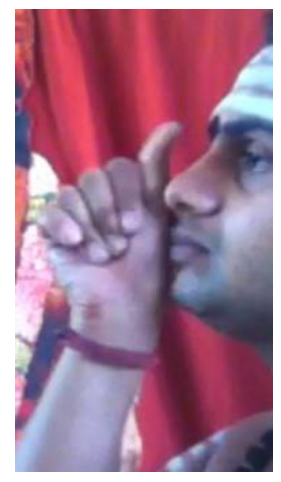
| Wash your right hand with the water in the Panchapatram. |
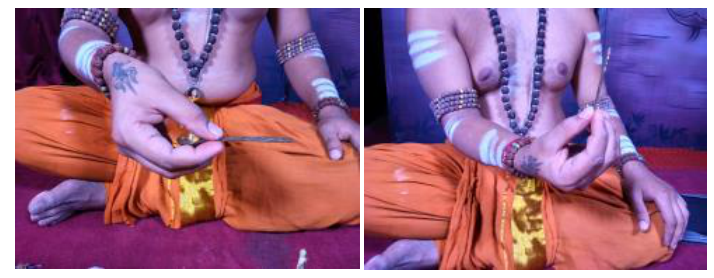
| | With the tips of the right hand index, middle and ring fingers, touch above the 1) upper lips and 2) below the lower lips |
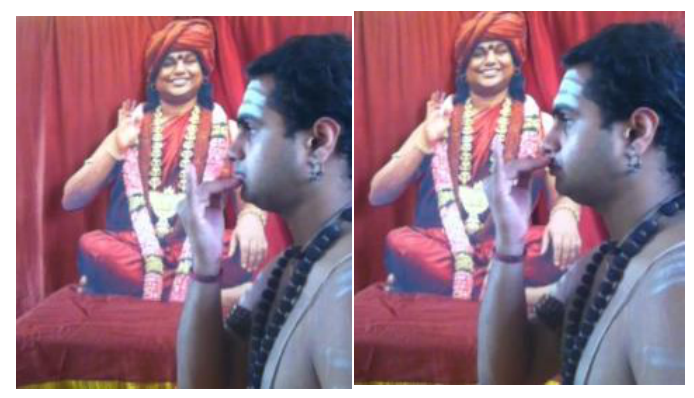
| | With the tips of the right hand index finger and thumb joined together touch 1) the right nostril 2) left nostril |
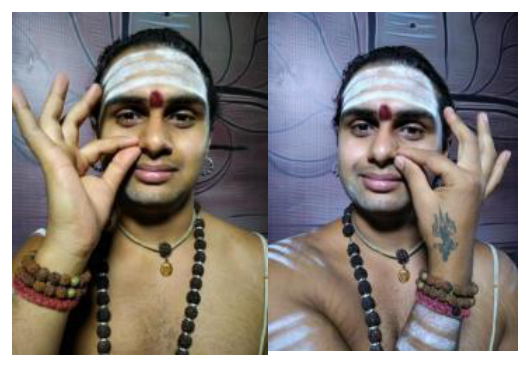
|
| With the tips of the right hand ring finger and thumb joined together, touch the 1)right eye 2)left eye 3)Right ear 4)Left ear |
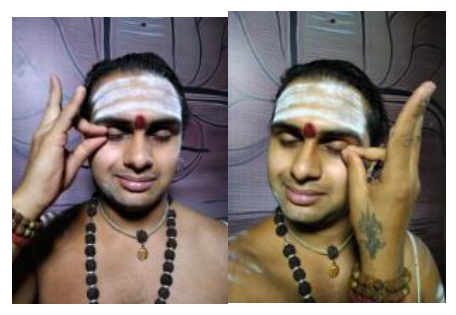
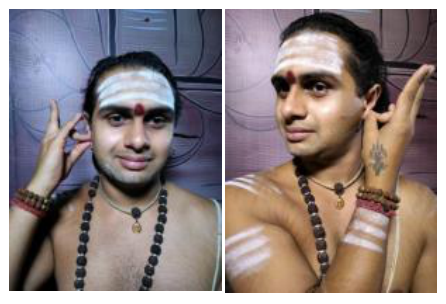
| | Wash your right hand with the water in the Panchapatram. | | | With the base of the right hand thumb and little finger, touch the 1) navel, 2) Right chest 3) left chest |
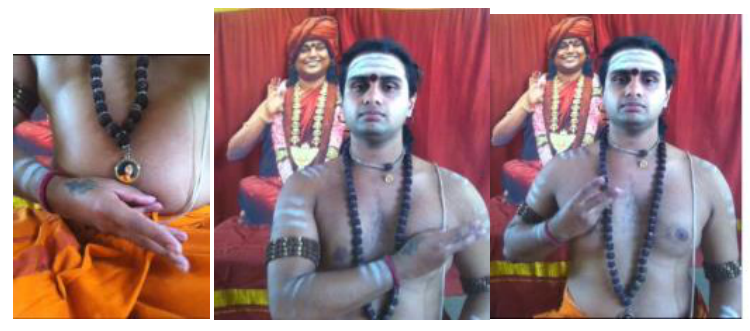
| | With the right hand finger tips together, touch the 1) top of the head, 2) right shoulder, 3) left shoulder 4) the heart center. |
|
॥ शुक्लम्बरधरम् ॥ ।। śuklambaradharam ।।
© 2019 Sri Nithyananda Swami. All Rights Reserved.
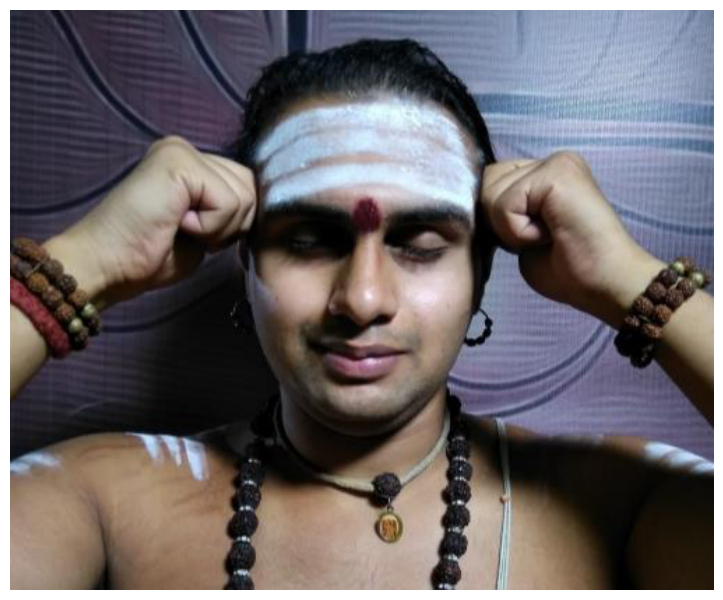
Please take the akshata(turmeric mixed rice) in you right hand. Clench your hands as shown in the picture and tap the sides of your forehead (on the temples) five times visualizing that the nectar in the Sushumna nadi reaching the Mahaganapathy in the Mooladhara chakra and the nectar oozing through the head and drenching your hands along with the chanting the following mantra
शुक्लाम्बरधरं विष्णुं शशिवर्णं चतुर्भुजम् ।
प्रसन्नवदनं ध्यायेत् सर्व-विघ्नोपशान्तये ॥
śuklāmbaradharaṁ viṣṇuṁ śaśivarṇaṁ caturbhujam।
prasannavadanaṁ dhyāyet sarva-vighnopaśāntaye ॥
॥ प्राणायामः ॥।। prāṇāyāmaḥ ।।
Continue to keep the akshata in your right hand. Now open only the little finger, ring finger and the thumb (as shown in picture). During the Pranayama use the thumb to close the right nostril and the ring and little finger to close the left nostril.
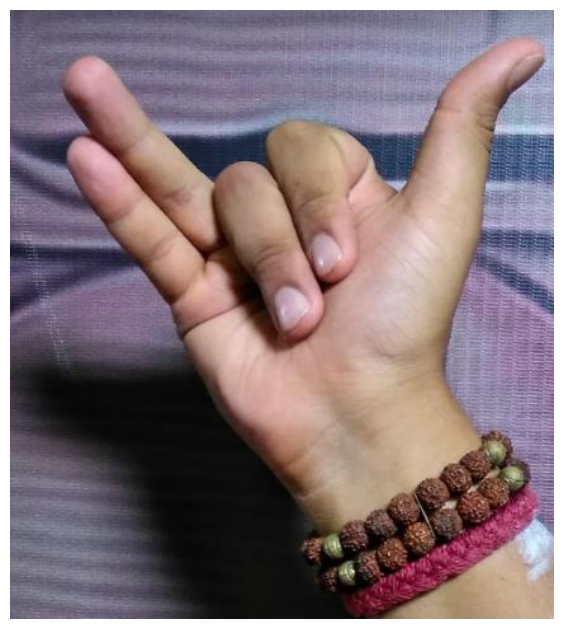
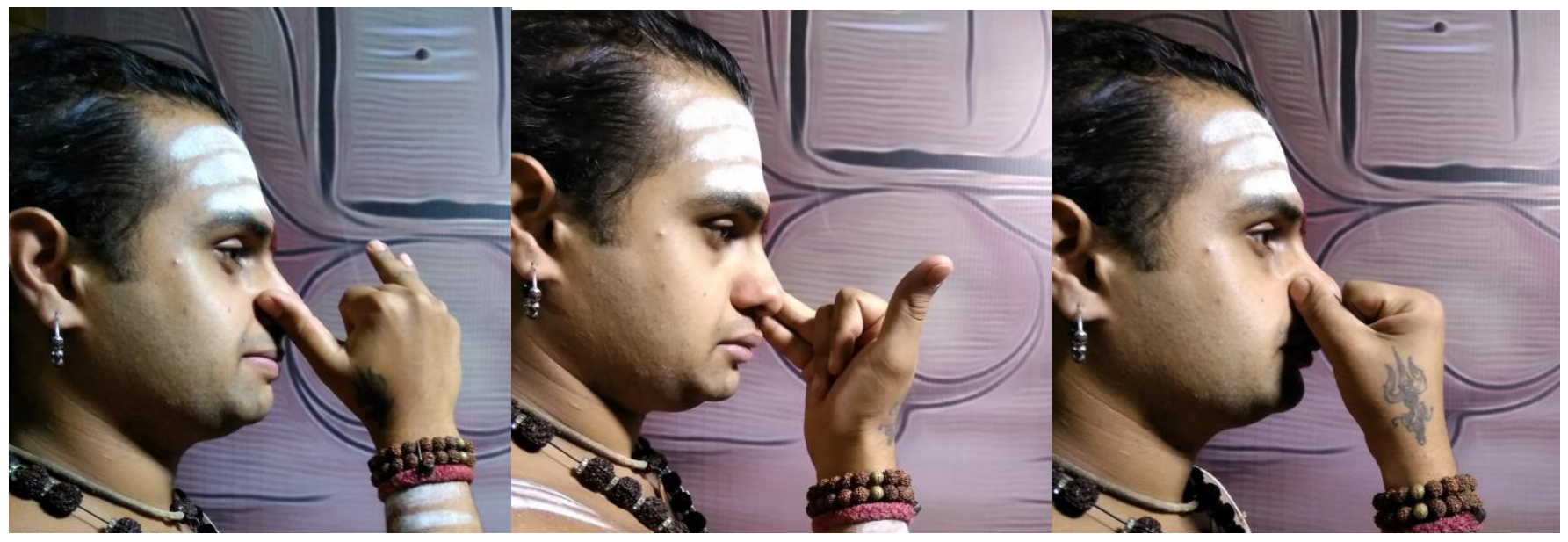
Position of hand for Pranayama
1) Closing the right nostril inhale slowly through the left nostril
2) Once you have inhaled fully, close both the nostrils and hold the breath inside as long as possible
3) Exhale through the right nostril alone very slowly
© 2019 Sri Nithyananda Swami. All Rights Reserved.
During this inhalation, retention and exhalation, chant the following mantras three times internally. (The following are called the Samhita mantras; the first five known as Pancha Brahma mantras and the next six mantras are called Shadanga mantras or Anga mantras)
| Pancha brahma mantras | Shadanga mantras | ||
|---|---|---|---|
| 1. | ॐ हों ईशानमूर्धाय नमः om hoṁ īśānamūrdhāya namaḥ {‘hom’ is to be chanted as short} | 6 | ॐ हां हृदयाय नमः om hāṁ hṛdayāya namaḥ |
| 2 | ॐ हें तत्पुरुषवक्त्राय नमः om heṁ tatpuruṣavaktrāya namaḥ {‘hem’ is to be chanted as short} | 7 | ॐ हीं शिरसे नमः om hīṁ śirase namaḥ |
| 3 | ॐ हुं अघोरहृदयाय नमः om huṁ aghorahṛdayāya namaḥ | 8 | ॐ हूं शिखायै नमः om hūṁ śikhāyai namaḥ |
| 4 | ॐ हिं वामदेवगुह्याय नमः om hiṁ vāmadevaguhyāya namaḥ | 9 | ॐ हैं कवचाय नमः om haiṁ kavacāya namaḥ |
| 5 | ॐ हं सद्योजातमूर्तये नमः om haṁ sadyojātamūrtaye namaḥ | 10 | ॐ हौं नेत्रेभ्यो नमः om hauṁ netrebhyo namaḥ |
| 11 | ॐ हः अस्त्राय नमः |
| om haḥ astrāya namaḥ |
|---|
॥ सङ्कल्पः ॥ ।। saṅkalpaḥ ।।
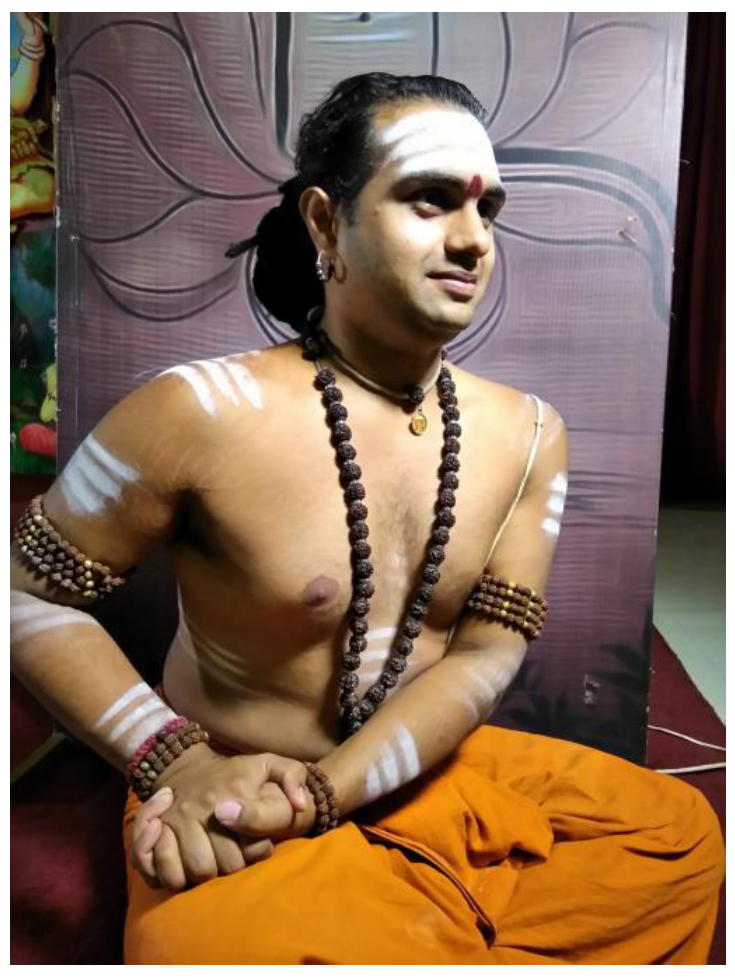
Now keeping the akshata in your left palm and close it with your right palm and keep both the hands on the right thigh, chant the following mantra and then drop the akshata down in the North at the end of the mantra.
When you make a conscious resolution in front of the Master, the power of the sankalpa itself will deliver the experience you are supposed to get through this paada puja. The meaning of the mantra we are going to chant now is: In order that the Master is pleased by the process of destruction of my Karmas and sins, I, for the benefit of myself and the near & dear ones in my life, during the second half of the life time of Lord Brahma, during the Kalpa called Shweta Varaha, during the regime of Vaivasvata Manau, during the first quarter of the age called Nitya Yuga, in the island called Jambu, in the continent called Bharata Varsha, in the Indian sub-continent called Bharatah Khanda, in the southern side of the Mt. Meru, in the Shaka era, during the Vedic year called ______ (current year's name) which is one of the set of sixty years which is in practice of which Prabhava is the first year, in the period of the year called______ Ayana (Uttara/Dakshina), in the season called ______ (name of the rituau), in the month called ______ (name of the month), in the waning phase of the moon called______ paksha (name of the phase of the moon), in the tithi called ______ tithi (name of the tithi), in the vedic day called ______ (name of the day), in the star called ______ nakshatra name of the nakshatra), during the yoga called ______ yoga, (name of the yoga), during the karana called ______ karana (Name of the karana) - During such an auspicious moment, for pleasing Sri la Sri Paramahamsa Nithayanda Sri Jnanasambandha Deshika Paramaacharaya Swami – the one who is the incarnation of the Tiru Jnanasambandha who has adorned the Shyaamalaa Peeta, who is the embodiment of Sri Meenakshi Sundareshwara, who is the favourite son of Lord Shiva, who is the incarnation who graced Himself as a young Guru, the one who, because of drinking the breast milk of Mother Parvati created the Dravida Veda which is the essence of the Vedas and the Agamas, the one who is the establisher of the pearl palanquin received by the grace of Lord Shiva, the one who is the reviver of the Shaiva tradition, the one who has adorned the seat of Omniscience, the one who is the Master of the Cosmos, such a Master who has adorned the scared seat of Omniscience previously adorned by Meenakshi Sundareshwara and revived by Tiru Jnanasambandhar, the one who is the 293rd Guru Maha sannidhanam of that spiritual kingdom revived by Tiru Janasambandar, the one who is the 1008 Shree Mahamandaleshwar of Mahanirvanipeeta, the Acharya whose feet has the qualities of dignity , majesty , distinction , excellence and beauty, the one who is the in the state of Paramahamsa, the Acharya of all Sannyaasis that is all the wandering monks, the one who is the embodiment of the sacred syllable OM, the one who is the embodiment of the pure Truth, Consciousness and Bliss, the one who is the knower of the Vedas, the one who is established in the Super Consciousness, the one who is the Jagadguru who founded the Maha Simhasana of the spiritual kingdom - the Nithyananda Dhyanapeeta which has festivity all around it all the time, which has auspiciousness, all great divine qualities, and which is ever-alluring, for gaining devotion at the lotus feet of Paramahamsa Nithyananda, for receiving the grace of the Master, for having growing security, fortitude, power, victory, longevity, health and wealth. For the fruition of the four goals of my life, that is – Dharma – living my life through righteous means, Artha – earning a living for myself through righteous means, Kama – fulfilling my desires through righteous means, and Moksha - liberation from all bondages that exist for me as a human being, for dissolving all my accumulated karmas, for receiving all auspiciousness, for living Enlightenment along with my whole near and ones by the grace of the Master, I am directly worshipping the feet of the Enlightened Master Nithyananda who is the embodiment of all the Gods and the Goddess.
ममोपात्त-समस्त-दुरित-क्षयद्वारा-भगवच्छ्री-नित्यानन्द-परमशिव-प्रीत्यर्थं श्री-नित्यानन्देश्वरी-पराशक्ति-समेत-श्री-
नित्यानन्देश्वर-परमशिव-प्रीत्यर्थं च शुभे शोभने मुहूर्ते अद्यब्रह्मणः द्वितीय-परार्धे श्री-श्वेत-वराह-कल्पे वैवस्वत-मन्वन्तरे
अष्टाविंशतितमे नित्ययुगे प्रथमे पादे _______ द्वीपे _______ वर्षे _______ खण्डे ( जम्बूद्वीपे भारतवर्षे
भरतखण्डे) मेरोः दक्षिणे पार्श्वे शकाब्दे अस्मिन्_______ वर्तमाने व्यवहारिके प्रभवादीनां षष्ट्याः संवत्सराणां मध्ये
_______-नाम-संवत्सरे _______-अयने _______-ऋतौ _______-मासे _______-पक्षे
_______-शुभतिथौ _______-वासर-युक्तायां _______-नक्षत्र _______-योग _______-करण-एवं-
गुण-विशेषण-विशिष्टायां अस्यां शुभतिथौ _______ नामधेयस्य _______ नाम्न्याः च सकुद्रुम्बस्य श्री-कैलासोन्नत-
द्वादशान्त-श्यामला-पीठा can be read as पीठारूढ श्री-मीनाक्षि-सुन्दरेश्वराभिन्न-स्वरूप परशिव-पुत्र-रत्न कुमार गुरुमण्युतुल्यावतार श्री-पार्वती-
स्तन्यपान-लब्ध-दिव्य-ज्ञान-विश्रुत-सकल-निगमागम-सारभूत-द्राविड-वेद-प्रवक्तृ श्रीमत्-परमशिव-करुणा-समधिगत-
मुक्तामय-चतुरश्रयान-गीयमान-छत्र-चामर-श्रीचिह्नकाहलादि-समस्त-बिरदावल्यलङ्कृत ज्ञान-विज्ञान-चक्रवर्ति सर्व-जन-
सङ्घ-सद्यो-निर्वाण-दीक्षाव्ययापवर्ग-वर्ष विश्राण जीमूत पर-मत-कलभ-केसरि शैव-सिद्धान्त-स्थापनाचार्य श्री-
राजाधिराज-पाण्ड्य-महाराज-गुरु क्षपण-शाक्यादि-महान्धकार-निवारण-ज्ञानभानु वीक्षणानर्हार्ह-ध्वजोच्छेदन्-पूर्वक-
श्रीमद्-वृषभ-ध्वज-स्थापक शैव-समय-कर्तृ सर्वज्ञपीठारूढ श्री-जगद्गुरु-श्री-ज्ञानसम्बन्ध-देशिक-स्वामि-वागीश-सुन्दर-माणिक्यवाचक-स्वामिनाम्-अवतार-भूत-श्री-ज्ञानसम्बन्ध-स्वामि-पुनरुद्धृत-श्यामलापीठ-महासंस्थान-ज्ञानसाम्राज्य-
शासक सर्वज्ञपीठारूढ त्रिनवत्युत्तर-द्विशततम-गुरुमहासन्निधान महानिर्वाणिपीठस्य-अष्टोत्तर-सहस्रश्री-महामण्डलेश्वर
अटलपीठस्य-अष्टोत्तर-सहस्रतम-अष्टोत्तर-सहस्रश्री-अटलपीठाधीश्वर धर्ममुक्ति-स्वर्गपुर-स्वर्णपीठस्य-त्रयोविंश-
गुरुमहासन्निधान श्रीमत्-परमहंस-परिव्राजकाचार्यवर्य-सच्चिदानन्द-प्रणवस्वरूप-श्रोत्रिय-ब्रह्मनिष्ठ-नित्योत्सव-नित्यमङ्गल-
नित्यकल्याण-नित्यरजित-नित्यानन्दपीठ-महासंस्थान-महासिंहासन-पीठ-कर्तृ कैलास-पुनरुद्धारक
जगद्गुरु-श्री-ल-श्री-भगवच्छ्री-नित्यानन्द-परमशिव-श्री-ज्ञानसम्बन्ध-देशिक-परमाचार्य-स्वामिनां प्रीत्यर्थं तेषां
पादारविन्दयोः भक्ति-सिद्धयर्थं गुरुकृपा-कटाक्ष-सिद्धयर्थं क्षेम-स्थैर्य-वीर्य-विजय-आयुरारोग्य-ऐश्वर्याणाम् अभिवृद्ध्यर्थं
धर्मार्थ-काम-मोक्ष-चतुर्विध-फल-पुरुषार्थ-सिद्धयर्थं समस्त- दुरितोप-शान्त्यर्थं समस्त-मङ्गल-अवाप्त्यर्थं भगवच्छ्री-
नित्यानन्द-परमशिव-प्रसादेन-सकुटुम्बस्य-ज्ञान-वैराग्य-जीवन्-मुक्ति-प्राप्त्यर्थं-श्री-नित्यानन्देश्वरी-पराशक्ति-समेत-श्री-
नित्यानन्देश्वर-परमशिव-अवतार-भूत-श्री-सर्व-देव-देवी-स्वरूप-भगवच्छ्री-नित्यानन्द-परमशिव-प्रत्यक्ष-पाद/पादुका-
पूजां श्री-नित्यानन्देश्वरी-पराशक्ति-समेत-श्री-नित्यानन्देश्वर-परमशिव-पूजां च करिष्ये ॥
|| saṅkalpaḥ ||
mamopātta-samasta-durita-kṣayadvārā-bhagavacchrī-nityānanda-paramaśiva-prītyarthaṁ śrī- nityānandeśvarī-parāśakti-sameta-śrī-nityānandeśvara-paramaśiva-prītyarthaṁ ca śubhe śobhane muhūrte adyabrahmaṇaḥ dvitīya-parārdhe śrī-śveta-varāha-kalpe vaivasvata-manvantare aṣṭāviṁśatitame nityayuge prathame pāde __________ dvīpe __________ varṣe __________ khaṇḍe (when the puja is done in India chant: jambu dvīpe bhāratavarṣe bharatha khaṇḍe) meroḥ dakṣiṇe pārśve śakābde asmin vartamāne vyavahārike prabhavādīnāṁ ṣaṣṭyāḥ saṁvatsarāṇāṁ madhye (fill these blanks referring to the panchangam – the Vedic almanac) __________-nāma __________-saṁvatsare __________-ayane __________-ṛtau __________-māse __________-pakṣe __________-śubhatithau __________-vāsara-yuktāyāṁ __________- nakṣatra __________-yoga __________-karaṇa-evaṁ-guṇa-viśeṣaṇa-viśiṣṭāyāṁ asyāṁ śubhatithau (chanting of the participants' name) __________nāmadheyasya (male) __________nāmnyāḥ (female) ca sakuṭumbasya śrī-kailāsonnata-dvādaśānta-śyāmalā-pīṭhārūḍha śrī-mīnākṣi-sundareśvarābhinna-svarūpa paraśiva-putra-ratna kumāra gurumaṇyatulyāvatāra śrī-pārvatī-stanyapāna-labdha-divya-jñāna-viśruta-sakala-nigamāgama-sārabhūta-drāviḍa-veda-pravaktṛ śrīmat-paramaśiva-karuṇā- samadhigata-muktāmaya-caturaśrayāna-gīyamāna-chatra-cāmara-śrīcihnakāhalādi-samasta-biradāvalyalaṅkṛta jñāna-vijñāna-cakravarti sarva-jana-saṅgha-sadyo-nirvāṇa-dīkṣāvyayāpavarga-varṣa viśrāṇa jīmūta para-mata-kalabha-kesari śaiva-siddhānta-sthāpanācārya śrī-rājādhirāja-pāṇḍya-mahārāja-guru kṣapaṇa-śākyādi-mahāndhakāra-nivāraṇa-jñānabhānu vikṣaṇānarhārha-dhvajocchedana-pūrvaka-śrīmad-vṛṣabha-dhvaja-sthāpaka śaiva-samaya-kartṛ sarvajñapīṭhārūḍha śrī- jagadguru-śrī-jñānasambandha-deśika-svāmi-vāgīśa-sundara-māṇikyavācaka-svāminām- avatāra-bhūta śrī-jñānasambandha-svāmi-punaruddhṛta-śyāmalāpīṭha-mahāsaṁsthāna-jñānasāmrājya-śāsaka sarvajñapīṭhārūḍha trinavatyuttara-dviśatatama-gurumahāsannidhāna mahānirvāṇipīṭhasya-aṣṭottara-sahasraśrī-mahāmaṇḍaleśvara aṭalapīṭhasya-aṣṭottara-sahasratama-aṣṭottara-sahasraśrī- aṭalapīṭhādhīśvara dharmamukti-svargapura-svarṇapīṭhasya-trayoviṁśa-gurumahāsannidhāna śrīmat-paramahaṁsa-parivrājakācāryavarya-saccidānanda-praṇavasvarūpa-śrotriya-brahmaniṣṭha-nityotsava-nityamaṅgala-nityakalyāṇa-nityarajita-nityānandapīṭha-mahāsaṁsthāna-mahāsiṁhāsana-pīṭha-kartṛ kailāsa-punaruddhāraka jagadguru-śrī-la-śrī-bhagavacchrī-nityānanda-paramaśiva-śrī- jñānasambandha-deśika-paramācārya- svāmināṁ prītyarthaṁ teṣāṁ pādāravindayoḥ bhakti-siddhyarthaṁ gurukṛpā-kaṭākṣa-siddhyarthaṁ kṣema-sthairya-vīrya-vijaya-āyurārogya-aiśvaryāṇām abhivṛddhyarthaṁ dharmārtha-kāma-mokṣa-caturvidha-phala-puruṣārtha-siddhyarthaṁ samasta-duritopa-śāntyarthaṁ samasta-maṅgala-avāptyarthaṁ bhagavacchrī-nityānanda-paramaśiva-prasādena-sakuṭumbasya-jñāna-vairāgya-jīvan-mukti-prāptyarthaṁ śrī-nityānandeśvarī-parāśakti-sameta-śrī- nityānandeśvara-paramaśiva-avatāra-bhūta-śrī-sarva-deva-devī-svarūpa- bhagavacchrī-nityānanda-paramaśiva-pratyakṣa-pāda/pādukā -pūjāṁ śrī-nityānandeśvarī-parāśakti-sameta-śrī-nityānandeśvara-paramaśiva-pūjāṁ ca kariṣye ॥
Wash your hand with the water in the Panchapatram as illustrated in the picture
अप उपस्पृश्य
apa upaspṛśya
॥ घण्टानादः ॥।। ghaṇṭānādaḥ ।।
Now ring the bell with your left hand loudly as you chant the mantra. The bell should never be rung holding it below your heart level.
आगमार्थं तु देवानां गमनार्थं तु रक्षसाम् ।
घण्टानादं करोम्यादौ देवताह्वान-लाञ्छनम् ॥
घण्टादेवताभ्यो नमः ॥
āgamārthaṁ tu devānāṁ gamanārthaṁ tu rakṣasām |
ghaṇṭānādaṁ karomyādau devatāhvāna-lāñcanam ||
ghaṇṭādevatābhyo namaḥ ||
|| मानसपूजा|| || mānasa pūja ||
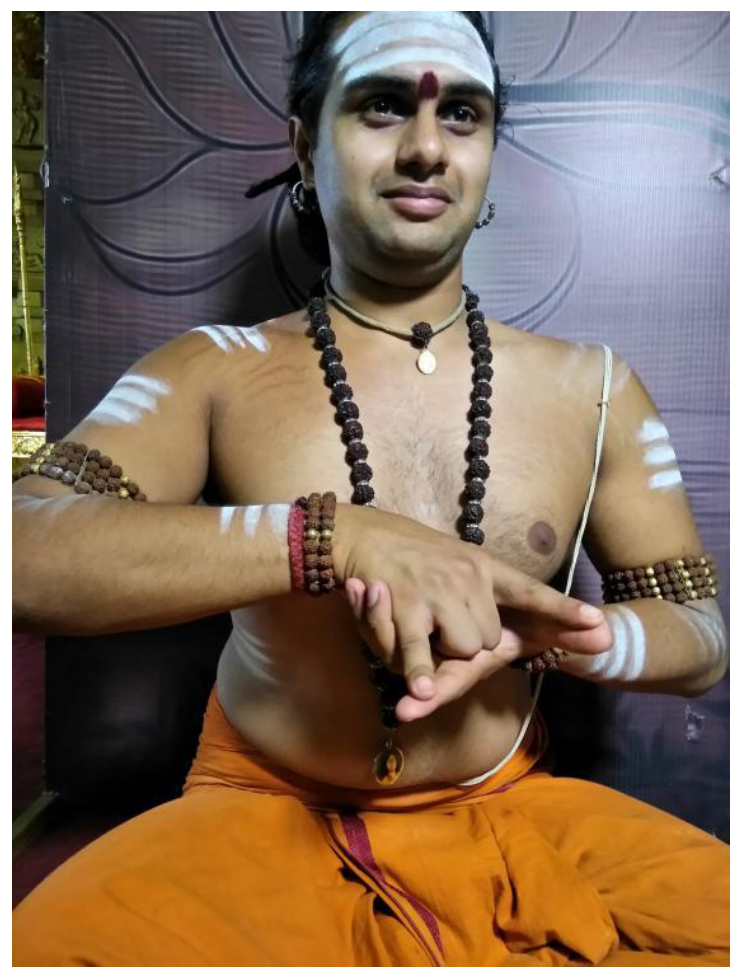
The meaning of the mantra we are going to chant now is:
What seat can I offer to the Master except my heart? I offer the gratitude flowing as nectar to wash His feet and to rinse His mouth. I offer my mind itself as the arghya - the bouquet.
To my Master who is the very Cosmos, what clothing can I offer except the space? I offer my very praana – life energy - as the incense and I offer the ocean of nectar as the food offering.
The principle of unstuck perennial sound is to be offered as the bell, the air as the chamara, the sahasraara as the umbrella, the principle of sound as the music, the actions of the senses and also the vagaries of the mind as the dance.
All the seven chakras along the Sushumna nadi is to be offered as a flower garland.
The different kinds of flowers with which the Sadguru should be worshipped are the guilelessness, freedom from the ego, freedom from suffering when your desires are not fulfilled, freedom from arrogance, freedom from ignorance, freedom from deceit, freedom from hatred, freedom from agitation, freedom from jealousy and greed and the Sadguru should also be worshipped with the flowers of non-violence, mastery over the senses, compassion, forgiveness and Enlightenment.
Now please take some flowers in your hands and place your hands in the Kurma mudra, close your eyes and offer the flowers at Swamiji’s feet/paduka at the end of the mantra.
॥ मानस-पूजा ॥
ॐ हृत्-पद्मम् आसनं दद्यात् सहस्रारच्युतामृतैः ।
पाद्यं चरणयोर्दद्यात् मनस्तु-अर्घ्यं निवेदयेत् ॥
तेन-अमृतेन आचमनीयं स्नानीयं तेन च स्मृतम्।
आकाश-तत्त्वं वस्त्रं स्यात् गन्धः स्यात् गन्ध-तत्त्वकम् ॥
चित्तं प्रकल्पयेत् पुष्पं धूपं प्राणान् प्रकल्पयेत् ।
तेजस्तत्त्वं च दीपार्थं नैवेद्यं स्यात्-सुधाम्बुधिः ॥
अनाहत-ध्वनिर्घण्टा वायु-तत्त्वं च चामरम् ।
सहस्रारं भवेत् छत्रं शब्द-तत्त्वं च गीतकम् ॥
नृत्यम् इन्द्रिय-कर्माणि चाञ्चल्यं मनसस्-तथा ।
सुमेखलां पद्म-मालां पुष्पं नाना-विधं तथा ॥
अमायाद्यैर्भाव-पुष्पैः अर्चयेत् भाव-गोचरम् ।
अमायम् अनहङ्कारम् अरागम् अमदं तथा ॥
अमोहकम् अदम्भं च अद्वेषाक्षोभकौ तथा ।
अमात्सर्यम् अलोभं च दश-पुष्पं विदुर्-बुधाः ॥
अहिंसा परमं पुष्पं पुष्पम् इन्द्रिय-निग्रहः ।
दया-पुष्पं क्षमा-पुष्पं ज्ञान-पुष्पं च पञ्चमम् ॥
इति पञ्चदशैर्भाव-पुष्पैः सम्पूजयेत् भगवन्तं श्री-नित्यानन्द-परमशिवम् ॥
।। mānasa-pūjā ।।
om hṛt-padmam āsanaṁ dadyāt sahasrāracyutāmṛtaiḥ ।
pādyaṁ caraṇayor-dadyāt manastu-arghyaṁ nivedayet ॥
tena-amṛtena ācamanīyaṁ snānīyaṁ tena ca smṛtam ।
ākāśa-tattvaṁ vastraṁ syāt gandhaḥ syāt gandha-tattvakam ॥
cittaṁ prakalpayet puṣpaṁ dhūpaṁ prāṇān prakalpayet ।
tejas-tattvaṁ ca dīpārthaṁ naivedyaṁ syāt-sudhāmbudhiḥ ||
anāhata-dhvanirghaṇṭā vāyu-tattvaṁ ca cāmaram |
sahasrāraṁ bhavet chatraṁ śabda-tattvaṁ ca gītakam ||
nṛṭyam indriya-karmāṇi cāṇscalyaṁ manasas-tathā |
sumekhalāṁ padma-mālāṁ puṣpaṁ nānā-vidhaṁ tathā ||
amāyādyair-bhāva-puṣpaiḥ arcayet bhāva-gocaram |
amāyam anahaṅkāram arāgam amadaṁ tathā ||
amohakam adambhaṁ ca adveṣākṣobhakau tathā |
amātsaryam alobhaṁ ca daśa-puṣpaṁ vidur-budhāḥ ||
ahiṁsā paramaṁ puṣpaṁ puṣpam indriya-nigrahaḥ |
dayā-puṣpaṁ kṣamā-puṣpaṁ jñāna-puṣpaṁ ca pañcamam ||
iti pañcadaśair-bhāva-puṣpaiḥ sampūjayet
bhagvantaṁ śrī-nityānanda-paramaśivam ||
॥ आसनम् ॥ ।। āsanam ।।
The meaning of the mantra we are going to chant now is: Oh! The one who resides inside all the beings, the one who is the very soul of all beings! I offer this seat to you; I surrender, I surrender.Now please take some flowers & akshata (turmeric rice) in your hands and offer at His Divine Holiness Swamiji's feet / paduka along with the mantra
ॐ सर्व-भूतान्तरस्थाय सर्व-भूतान्तरात्मने। कल्पयाम्युपवेशार्थम् आसनं ते नमो नमः॥
ॐ ह्रीम् इदं सुवर्णासनं सर्व-देव-देवी-स्वरूपाय भगवते श्री-नित्यानन्द-परमशिवाय नमः॥
om sarva-bhūtāntarasthāya sarva-bhūtāntarātmane |
kalpayāmyupaveśārtham āsanaṁ te namo namaḥ ||
|| om hrīm idaṁ suvarṇāsanaṁ sarva-deva-devī-svarūpāya bhagavate śrī-nityānanda-paramaśivāya
namaḥ ||
॥ स्वागतम् ॥।। svāgatam ।।
The meaning of the mantra we are going to chant now is: Oh! The Lord of all Gods, Oh! The one, whose darshan is awaited by Gods for the fulfillment of their desires! Welcome! Welcome! Today my birth, life, and all deeds are fructified; the fruits of all my tapas is materialized just by welcoming you. Now please take some flowers in your hands and offer the flowers at His Divine Holiness Swamiji's feet / paduka along with the mantra.
ॐ शान्तत्वात् सर्व-कर्तृत्वात् भावोपरति-कारणात् ।
शिव उक्तो महा-तन्त्र-मन्त्रविद्भिः सदाशिवः ॥
तस्मै शिवाय गुरवे वीतराग-कलाय वै ।
अमेयत्वात् अनन्तोऽयम् अजत्वाच्च प्रकीर्तितः ॥
यस्य दर्शनम् इच्छन्ति देवाः स्वाभीष्ट-सिद्धये ।
तस्मै ते परमेशान स्वागतं स्वागतं प्रभो ॥
अद्य मे सफलं जन्म जीवनं सफलाः क्रियाः ।
स्वागतं यत्-त्वया तन्-मे तपसां फलमागतम् ॥
ॐ ह्रीं सर्व-देव-देवी-स्वरूप- भगवन् श्री-नित्यानन्द-परमशिव -स्वागतं सुस्वागतं ते ॥
om śāntatvāt sarva-kartṛtvāt bhāvoparati-kāraṇāt |
śiva-ukto mahā-tantra-mantravidbhiḥ sadāśivaḥ ||
tasmai śivāya gurave vītarāga-kalāya vai |
ameyatvāt ananto'yam ajatvācca prakīrtitaḥ ||
yasya darśanam icchanti devāḥ svābhīṣṭa-siddhaye |
tasmai te parameśāna svāgatam svāgatam prabho ||
adya me saphalaṁ janma jīvanaṁ saphalāḥ kriyāḥ |
svāgataṁ yat-tvayā tan-me tapasāṁ phalamāgatam ||
om hrīṁ sarva-deva-devī-svarūpa- bhagavan śrī-nityānanda-paramaśiva svāgataṁ susvāgataṁ te ||
॥ पाद्यम् ॥।। pādyam ॥
The meaning of the mantra we are going to chant now is: I offer padyam that is the water for washing the feet of the Supreme God, the very devotion on whom brings about the ultimate bliss. Now please take uddharini of water in your hands and offer it at His Divine Holiness Swamiji's feet / paduka along with the mantra.
ॐ यद्-भक्ति-लेश-सम्पर्कात् परमानन्द-संप्लवः ।
तस्मै ते परमेशान पाद्यं शुद्धाय कल्पये ॥
ॐ ह्रीम् एतत्-पाद्यं सर्व-देव-देवी-स्वरूपाय भगवते श्री-नित्यानन्द-परमशिवाय नमः ॥
om yad-bhakti-leśa-samparkāt paramānanda-samplavaḥ |
tasmai te parameśāna pādyaṁ śuddhāya kalpaye ||
om hrīm etat-pādyaṁ sarva-deva-devī-svarūpāya bhagavate śrī-nityānanda-paramaśivāya namaḥ ||
॥ अर्घ्यः ॥।। arghyaḥ ।।
The next offering is Arghya - the offering of the traditional bouquet. The meaning of the mantra we are going to chant now is: Oh! Maheshwara! Please accept this arghya - offering of the traditional bouquet with water to welcome the guest - made of durva grass, a flower & a bilwa leaf and a rice pellet, and, kept in a beautiful conch.Now please take the conch in your hands and offer the Arghya at His Divine Holiness Swamiji's feet / paduka along with the mantra.
ॐ दुर्वाक्षत-समायुक्तं बिल्व-पत्रं तथा परम्।
शोभनं शङ्खपात्रस्थं गृहाणार्घ्यं महेश्वर॥
ॐ ह्रीम् एषोऽर्घ्यः सर्व-देव-देवी-स्वरूपाय भगवते श्री-नित्यानन्द-परमशिवाय स्वाहा॥
om durvākṣata -samāyuktaṁ bilva-patraṁ tathā param |
śobhanaṁ śaṅkha-pātrasthaṁ gṛhāṇārghyaṁ maheśvara ||
om hrīm eṣo'rghyaḥ sarva-deva-devī-svarūpāya bhagavate śrī-nityānanda-paramaśivāya svāhā ||
॥ आचमनीयम् ॥।। ācamanīyam ।।
The next offering is Achamaniyam – the offering of water for mouth wash. The meaning of the mantra we are going to chant now is: Please accept this auspicious and sin-removing Ganga water offered by me as Achamaniyam that is the water for mouth wash offered by me with devotion to you
Now please take an uddharini of water your hands and offer it at His Divine Holiness Swamiji's feet /paduka, along with the mantra.
ॐ मन्दाकिन्यास्तु यद् -वारि सर्व-पाप-हरं शुभम्।
गृहाणाचमनीयं त्वं मया भक्त्या निवेदितम्॥
ॐ ह्रीम् इदम् आचमनीयोदकं सर्व-देव-देवी-स्वरूपाय भगवते श्री-नित्यानन्द-परमशिवाय स्वधा ॥
om mandākinyāstu yad-vāri sarva-pāpa-haraṁ śubham |
gṛhāṇācamanīyaṁ tvaṁ mayā bhaktyā niveditam ||
om hrīm idam ācamanīyodakaṁ sarva-deva-devī-svarūpāya bhagavate śrī-nityānanda-paramaśivāya svadhā ||
॥ मधुपर्कः ॥।। madhuparkaḥ ।।
The meaning of the mantra we are going to chant now is:
For the destruction of all negativities, I offer this Madhuparka – this drink which is full of nectar. Be pleased towards me, Oh! Lord!
Now please take the Madhu Parka and offer at the His Divine Holiness Swamiji's feet / paduka along with the mantra.
ॐ सर्व-कल्मष-नाशाय परिपूर्ण-सुधात्मकम्। मधुपर्कमिमं देव कल्पयामि प्रसीद मे ॥
ॐ ह्रीम् एष मधुपर्कः सर्व-देव-देवी-स्वरूपाय भगवते श्री-नित्यानन्द-परमशिवाय स्वधा ॥
om sarva-kalmaṣa-nāśāya paripūrṇa-sudhātmakam ।
madhuparkamimaṁ deva kalpayāmi prasīda me ॥
om hrīm eṣa madhuparkaḥ sarva-deva-devī-svarūpāya bhagavate śrī-nityānanda-paramaśivāya svadhā ॥
॥ गन्ध-तैलम् ॥।। gandha-tailam ॥
The meaning of the mantra we are going to chant now is:
I offer with love and affection, this scented oil to you, Oh! The Healer of all the worlds! You are the purest among all the worlds.
Now please take the Gandha Tailam – the scented oil in your hands and offer at His Divine Holiness Swamiji's feet / paduka along with the mantra.
ॐ स्नेहं गृहाण स्नेहेन लोकानां हित-कारक ।
सर्व-लोकेषु शुद्धस्त्वं ददामि स्नेहमुत्तमम् ॥
ॐ ह्रीम् इदं गन्ध-तैलं सर्व-देव-देवी-स्वरूपाय भगवते श्री-नित्यानन्द-परमशिवाय निवेदयामि ॥
om snehaṁ gṛhāṇa snehena lokānāṁ hita-kāraka |
sarva-lokeṣu śuddhastvaṁ dadāmi snehamuttamam ||
om hrīm idaṁ gandha-tailaṁ sarva-deva-devī-svarūpāya bhagavate śrī-nityānanda-paramaśivāya nivedayāmi ||
॥ स्नानीयम् ॥॥ snānīyaṁ ॥
The meaning of the mantra we are going to chant now is:
Please accept this cool, pure and clear water which is capable of ceasing my mind, for your sacred bath offered by me with devotion to you.
Now please take an uddharini of water in your hands and offer at His Divine Holiness Swamiji's feet / paduka along with the mantra and please ring the bell as you do so.
ॐ इदं सुशीतलं वारि स्वच्छं शुद्धं मनोहरम् ।
स्नानार्थं ते मया भक्त्या कल्पितं प्रतिगृह्यताम् ॥
ॐ ह्रीम् इदम् स्नानीयोदकं सर्व-देव-देवी-स्वरूपाय भगवते श्री-नित्यानन्द-परमशिवाय निवेदयामि ॥
om idaṁ suśītalaṁ vāri svacchaṁ śuddhaṁ manoharam |
snānārthaṁ te mayā bhaktyā kalpitaṁ pratigṛhyatām ||
om hrīm idam snānīyodakaṁ sarva-deva-devī-svarūpāya bhagavate śrī-nityānanda-paramaśivāya nivedayāmi ||
॥ वस्त्रम् ॥।। vastram ।।
The meaning of the mantra we are going to chant now is:
I offer vastram – this clothe offering to the Master who removes the veil of Maya or illusion, the Master who is the true light of enlightenment, who does not have a veil of Maya, and has the very space as the dress.
Now please take the offering of clothes in your hands and offer it to His Divine Holiness Swamiji's feet / paduka along with the mantra.
ॐ माया-चित्र-पटाच्छन्न-निज-गुह्योरु-तेजसे ।
निरावरण-विज्ञाय वासस्ते कल्पयाम्यहम्॥
ॐ ह्रीम् इदं वस्त्रोत्तरीयं सर्व-देव-देवी-स्वरूपाय भगवते श्री-नित्यानन्द-परमशिवाय निवेदयामि ॥
om māyā-citra-paṭācchanna-nija-guhyoru-tejase |
nirāvaraṇa-vijṣāya vāsaste kalpayāmyaham ||
om hrīm idaṁ vastrottarīyaṁ sarva-deva-devī-svarūpāya bhagavate śrī-nityānanda-paramaśivāya nivedayāmi ||
॥ आभरणम् ॥।। ābharaṇam ।।
The meaning of the mantra we are going to chant now is:
I offer this golden ornament to you Master, who, by very nature has a very gracefully beautiful body and who is the repository of all powers. May you be pleased!
Now please take the jewellery in your hands and offer it at His Divine Holiness Swamiji's feet / paduka along with the mantra.
ॐ स्वभाव-सुन्दराङ्गाय नाना शक्त्याश्रयाय ते ।
सुवर्णं भूषणं तुभ्यं कल्पयामि प्रसीद मे ॥
ॐ ह्रीम् इदं सुवर्णाभरणम् सर्व-देव-देवी-स्वरूपाय भगवते श्री-नित्यानन्द-परमशिवाय निवेदयामि ॥
om svabhāva-sundarāṅgāya nānā śaktyāśrayāya te |
suvarṇaṁ bhūṣaṇaṁ tubhyaṁ kalpayāmi prasīda me ||
om hrīm idaṁ suvarṇābharaṇam sarva-deva-devī-svarūpāya bhagavate śrī-nityānanda-paramaśivāya nivedayāmi।।
॥ गन्धः ॥।। gandhaḥ ।।
The meaning of the mantra we are going to chant now is:
I neither know what your body is nor do I know what your actions are. Please accept and smear this sandalwood paste offered by me.
Now please take the sandalwood paste in your hands and offer it at His Divine Holiness Swamiji's feet / paduka along with the mantra.
ॐ शरीरं ते न जानामि चेष्टां नैव च नैव च ।
मया निवेदितान् गन्धान् प्रतिगृह्य विलिप्यताम् ॥
ॐ ह्रीम् एष गन्धः सर्व-देव-देवी-स्वरूपाय भगवते श्री-नित्यानन्द-परमशिवाय नमः ॥
om śarīraṁ te na jānāmi ceṣṭāṁ naiva ca naiva ca |
mayā niveditān gandhān pratigṛhya vilipyatām ||
om hrīm eṣa gandhaḥ sarva-deva-devī-svarūpāya bhagavate śrī-nityānanda-paramaśivāya namaḥ ||
॥ पुष्पम् ॥।| puṣpam ||
The meaning of the mantra we are going to chant now is:
Please accept these blissfully fragrant, different kinds of flowers which are taken from the forest of Turiya, that is, the space of ultimate restful awareness.
Now please take some flowers smeared with sandalwood paste in your hands and offer the flowers at His Divine Holiness Swamiji's feet / paduka along with the mantra.
ॐ तुरीय-वन-सम्पन्नं नाना-गुण-मनोहरम् ।
आनन्द-सौरभं पुष्पं गृह्यताम् इदम् उत्तमम् ॥
ॐ ह्रीम् एतानि सचन्दन-पुष्पाणि सर्व-देव-देवी-स्वरूपाय भगवते श्री-नित्यानन्द-परमशिवाय वौषट् ॥
om turīya-vana-sampannaṁ nānā-guṇa-manoharam |
ānanda-saurabhaṁ puṣpaṁ gṛhyatām idam uttamam ||
om hrīm etāni sacandana-puṣpāṇi sarva-deva-devī-svarūpāya bhagavate śrī-nityānanda-paramaśivāya vauṣaṭ ||
॥ बिल्वपत्रम् ॥॥ bilva-patram ॥
The meaning of the mantra we are going to chant now is: I offer you, Oh! God of all gods! this holy bilwa leaf in which dwells the Goddess of richness and which is so much loved by Lord Shiva. Now please take the Bilva leaf smeared with sandalwood paste in your hands and offer it at His Divine Holiness Swamiji's feet / paduka along with the mantra.
ॐ अमृतोद्भवं श्री-वृक्षं शङ्करस्य सदा-प्रियम्।
बिल्व-पत्रं प्रयच्छामि पवित्रं ते सुरेश्वर॥
ॐ ह्रीम् एतानि सचन्दन-बिल्व-पत्राणि सर्व-देव-देवी-स्वरूपाय भगवते श्री-नित्यानन्द-परमशिवाय वौषट्॥
om amṛtodbhavaṁ śrī-vṛkṣaṁ śaṅkarasya sadā-priyam |
bilva-patraṁ prayacchāmi pavitraṁ te sureśvara ||
om hrīm etāni sacandana-bilva-patrāṇi sarva-deva-devī-svarūpāya bhagavate śrī-nityānanda-paramaśivāya vauṣaṭ। |
॥ तुलसीपत्रम् ॥।। tulasī-patram ।।
The meaning of the mantra we are going to chant now is: Let this offering of Tulasi leaf be unto the Supreme Soul, who has unlimited forms and who is the bestower of all boons.
Now please take the Tulasi leaf smeared with sandalwood paste in your hands and offer it at His Divine Holiness Swamiji's feet / paduka along with the mantra.
ॐ नम॑स्ते बहु-रूपा॑य वरद॒मूर्त॑ये परमात्मने स्वाहा ॥
ॐ ह्रीम् इदं सचन्दन-तुलसी-पत्रं सर्व-देव-देवी-स्वरूपाय भगवते श्री-नित्यानन्द-परमशिवाय नमः ॥
om namaste bahu-rūpāya varadamūrtaye paramātmane svāhā ||
om hrīm idaṁ sacandana-tulasī-patraṁ sarva-deva-devī-svarūpāya bhagavate śrī-nityānanda-paramaśivāya namaḥ||
॥ धूपः ॥।। dhūpaḥ ।।
The meaning of the mantra we are going to chant now is:
This incense smoke is made of sacred herbs of intoxicating fragrance. Please accept this incense smoke fit to be inhaled by all the Devas.
Now please take the lit incense sticks in your hands and slowly wave towards His Divine Holiness Swamiji's feet / paduka along with the mantra and please ring the bell as you do so.
ॐ वनस्पति-रसो दिव्यो गन्धाढ्यः सुमनोहरः ।
आघ्रेयः सर्व-देवानां धूपोयं प्रतिगृह्यताम् ॥
ॐ ह्रीम् एष धूपः सर्व-देव-देवी-स्वरूपाय भगवते श्री-नित्यानन्द-परमशिवाय नमः ॥
om vanaspati-raso divyo gandhāḍhyaḥ sumanoharaḥ |
āghreyaḥ sarva-devānāṁ dhūpoyaṁ pratigṛhyatām ||
om hrīm eṣa dhūpaḥ sarva-deva-devī-svarūpāya bhagavate śrī-nityānanda-paramaśivāya namaḥ ||
॥ दीपः ॥।। dīpaḥ ।।
The meaning of the mantra we are going to chant now is:
Please accept this light of inner and outer worlds which is very bright and removes darkness from everywhere.
Now please take the lit lamp in your hands and slowly wave towards His Divine Holiness Swamiji's feet / paduka along with the mantra and please ring the bell as you do so.
ॐ सुप्रकाशो महा-दीपः सर्वतस्तिमिरापहः ।
सबाह्याभ्यन्तर-ज्योतिः दीपोयं प्रतिगृह्यताम् ॥
ॐ ह्रीम् एष दीपः सर्व-देव-देवी-स्वरूपाय भगवते श्री-नित्यानन्द-परमशिवाय नमः ॥
om suprakāśo mahā-dīpaḥ sarvatastimirāpahaḥ |
sabāhyābhyantara-jyotiḥ dīpoyaṁ pratigṛhyatām ||
om hrīm eṣa dīpaḥ sarva-deva-devī-svarūpāya bhagavate śrī-nityānanda-paramaśivāya namaḥ ||
॥ नैवेद्यम् ॥।। naivedyam ।।
The meaning of the mantra we are going to chant now is:These different kinds of food offerings are prepared from sweetener and other ingredients, Oh! Lord! Please accept this food offering prepared by me with devotion.
Now take a uddharini of water and hover it clockwise over the Naivedyam. Please chant the mantra and ring the bell as you do so.
ॐ नैवेद्यं विविधं देव शर्करादि-विनिर्मितम्।
मया निवेदितं भक्त्या गृहाण परमेश्वर ॥
om naivedyaṁ vividhaṁ deva śarkarādi-vinirmitam |
mayā niveditaṁ bhaktyā gṛhāṇa parameśvara ||
Now please offer the water in the uddharini on the Guru Paduka.
ॐ ह्रीम् इदं सोपकरण-नैवेद्यं सर्व-देव-देवी-स्वरूपाय भगवते श्री-नित्यानन्द-परमशिवाय निवेदयामि ॥
om hrīm idaṁ sopakaraṇa-naivedyaṁ sarva-deva-devī-svarūpāya bhagavate śrī-nityānanda-paramaśivāya nivedayāmi ||
॥ पानीयम् ॥।। pāyam ||
The meaning of the mantra we are going to chant now is:
Oh! God! The Lord of all demi-gods! The one who bestows deep fulfillment upon us! Please accept this water full of infinite bliss. Now please an uddharini water in your hands and offer it at His Divine Holiness Swamiji's feet / paduka after the mantra.
ॐ समस्त-देव-देवेश सर्व-तृप्ति-करं परम् ।
अखण्डानन्द-सम्पूर्णम् गृहाण जलम् उत्तमम् ॥
ॐ ह्रीम् इदं पानार्थोदकं सर्व-देव-देवी-स्वरूपाय भगवते श्री-नित्यानन्द-परमशिवाय नमः ॥
om samasta-deva-deveśa sarva-tṛpti-karaṁ param |
akhaṇḍānanda-sampūrṇam gṛhāṇa jalam uttamam ||
om hrīm idaṁ pānārthodakaṁ sarva-deva-devī-svarūpāya bhagavate śrī-nityānanda-paramaśivāya namaḥ||
॥ पुनराचमनीयम् ॥|| punarāamanīyam ||
The meaning of the mantra we are going to chant now is:
I offer this water for washing the hands and mouth to you whose mere remembrance purifies everybody. Now take an uddharini of water in your hands and offer it at His Divine Holiness Swamiji's feet / paduka after the mantra.
ॐ उच्छिष्ट- मप्य -शुचिर्वा यस्य स्मरण-मात्रतः ।
शुद्धिम् आप्नोति तस्मै ते पुनराचमनीयकम् ॥
ॐ ह्रीम् इदं पुनराचमनीयोदकं सर्व-देव-देवी-स्वरूपाय भगवते श्री-नित्यानन्द-परमशिवाय स्वाहा ॥
om ucchiṣṭa-mapya-śucirvā yasya smaraṇa-mātrataḥ |
śuddhim āpnoti tasmai te punarācamanīyakam ||
om hrīm idaṁ punarācamanīyodakaṁ sarva-deva-devī-svarūpāya bhagavate śrī-nityānanda-paramaśivāya svāhā ||
॥ आरात्रिकम् ॥।। ārātrikam ।।
The meaning of the mantra we are going to chant now is:
We salute to the Kubera who blesses us with wealth, who is the supreme of the kings, the one who possesses great patience. Let Lord Kameshwara – the Lord of desire energy fulfill our desires. I offer my pranams that is worship and salutations to the one who is as pure as camphor, the one who has incarnated because of intense compassion, the one who is the very essence of life, the one who has the king of serpents as his ornament, the one who lives eternally in the lotus of the heart and the one who has both the Shiva energy that is the cosmic masculine energy and the Devi energy that is the cosmic feminine energy at its peak! I offer my pranams to you!
Now please take the lit camphor in your hands and slowly wave towards Swamiji along with the mantra. Please ring the bell as you do so.
ॐ हीम् एषा दीप-माला सर्व-देव-देवी-स्वरूपाय भगवते श्री-नित्यानन्द-परमशिवाय नमः ॥
ॐ राजाधिराजाय-प्रसह्य-साहिने॑ नमो वयं वैश्रवणाय कुर्महे ।
स मे कामान्कामकामाय॒ मह्यम् ॥
कामेश्वरो वैश्रवणो ददातु ।
कुबेराय वै श्रवणाय महाराजाय नमः ॥
कर्पूर-गौरं करुणावतारं संसार-सारं भुजगेन्द्र-हारम् ।
सदा-वसन्तं हृदयारविन्दे भवं भवानी-सहितं नमामि ॥
आरात्रिकं समर्पयामि भगवच्छ्री-नित्यानन्द-परमशिव-चरण-कमलेभ्यो नमः ॥
om hrīm eṣā dīpa-mālā sarva-deva-devī-svarūpāya bhagavate śrī-nityānanda-paramaśivāya namaḥ।।
om rājādhirājāya prasahya-sāhine namo vayaṁ vaiśravaṇāya kurmahe |
sa me kāmānkāmakāmāya mahyaṁ ||
kāmeśvaro vaiśravaṇo dadātu |
kuberāya vai śravaṇāya mahārājāya namaḥ ||
karpūra-gauraṁ karuṇāvatāraṁ saṁsāra-sāraṁ bhujagendra-hāram |
sadā-vasantaṁ hṛdayāravinde bhavaṁ bhavānī-sahitaṁ namāmi ||
ārātrikaṁ samarpayāmi bhagavacchrī-nityānanda-paramaśiva-caraṇa-kamalebhyo namaḥ ||
॥ पुष्पाञ्जलिः ॥।। puṣpāñjaliḥ।
Now please take a few flowers in your hands, close your eyes till the end of the mantra and offer the flowers at His Divine Holiness Swamiji's feet / paduka at the end of the mantra.
The next offering is Pushpanjali – the offering of fragrant flowers. The meaning of the mantra we are going to chant now is: Guru is the Brahma who is the source of creation of the universe, Vishnu who is the source of sustenance of the universe, and Shiva who is the source of rejuvenation of the universe. Guru is all the three put together in a single form. I surrender to that Guru. I surrender to the Guru who is omnipresent and also has given me a glimpse of his experience. I surrender to the Guru who has with the brush of wisdom opened my eyes blinded by ignorance. I surrender to the Guru who by giving the knowledge about the Self, has burnt my Karmic baggage of so many births. I surrender to the Guru who is the Lord of the Cosmos, who is the Guru of the Cosmos; my soul is the same soul which is in all the beings. I surrender to Dakshinamurthy – the primal Guru – who manifests Himself differently in the form of Iswara, Guru and Atman or the self. I surrender to that Sadguru who is the eternal bliss, bestower of supreme happiness, the one who is the embodiment of wisdom, who is beyond duality, who is omnipresent, to whom the Supreme goal is giving the Enlightenment experience, who is eternal, pure and unshakable, who is the silent spectator of all thought processes, who is beyond emotions, who is without the three qualities called Sattva, Rajas and Tamas. Now please take a few flowers in your hands, close your eyes till the end of the mantra and offer the flowers at Swamiji's feet/paduka at the end of the mantra.
गुरुर्ब्रह्मा गुरुर्विष्णुः गुरुर्देवो महेश्वरः।
गुरुः साक्षात् परं ब्रह्म तस्मै श्री-गुरवे नमः॥
खण्डमण्डलाकारं व्याप्तं येन चराचरम्।
तत्पदं दर्शितं येन तस्मै श्री-गुरवे नमः॥
अज्ञान-तिमिरान्धस्य ज्ञानाञ्जन-शलाकया।
चक्षुरुन्मीलितं येन तस्मै श्री-गुरवे नमः॥
अनेक-जन्म-सम्प्राप्त-कर्म-बन्ध-विदाहिने।
आत्म-ज्ञान-प्रदानेन तस्मै श्री-गुरवे नमः॥
मन्नाथः श्री-जगन्नाथो मद्गुरुः श्री-जगद्गुरुः।
ममात्मा सर्व-भूतात्मा तस्मै श्री-गुरवे नमः॥
ईश्वरो गुरुरात्मेति मूर्ति-भेद-विभागिने ।
व्योमवद्- व्याप्त -देहाय दक्षिणामूर्तये नमःअ ॥
नित्यानन्दं परमसुखदं केवलं ज्ञानमूर्तिं
द्वन्द्वातीतं गगनसदृशं तत्त्वमस्यादि-लक्ष्यम् ।
एकं नित्यं विमलम् अचलं सर्वधी-साक्षि-भूतं
भावातीतं त्रिगुण-रहितं सद्गुरुं तम् नमामि ॥
पुष्पाञ्जलिं समर्पयामि भगवच्छ्री-नित्यानन्द-परमशिव-चरण-कमलेभ्यो नमः ।
॥ ॐ नित्यानन्दम् ॥
gururbrahmā gururviṣṇuḥ gururdevo maheśvaraḥ |
guruḥ sākṣāt paraṁ brahma tasmai śrī-gurave namaḥ ||
akhaṇḍamaṇḍalākāraṁ vyāptaṁ yena carācaram |
tatpadaṁ darśitaṁ yena tasmai śrī-gurave namaḥ ।।
ajṣāna-timirāndhasya jṣānāsjana-śalākayā ।
cakṣurunmīlitaṁ yena tasmai śrī-gurave namaḥ ।।
aneka-janma-samprāpta-karma-bandha-vidāhine ।
ātma-jṇāna-pradānena tasmai śrī-gurave namaḥ ।।
fmannāthaḥ śrī-jagannātho madguruḥ śrī-jagadguruḥ ।
mamātmā sarva-bhūtātmā tasmai śrī-gurave namaḥ ।।
īśvaro gururātmeti mūrti-bheda-vibhāgine ।
vyomavad- vyāpta -dehāya dakṣiṇāmūrtaye namaḥa ।।
nityānandaṁ paramasukhadaṁ kevalaṁ jṣānamūrtiṁ
dvandvātītaṁ gaganasadṛśaṁ tattvamasyādi-lakṣyam ।
ekaṁ nityaṁ vimalaṁ acalaṁ sarvadhī-sākṣi-bhūtaṁ
bhāvātītaṁ triguṇa-rahitaṁ sadguruṁ tam namāmi ||
|| puṣpāñjaliṁ samarpayāmi bhagavacchrī-nityānanda-paramaśiva-caraṇakamalebhyo namaḥ ||
|| om nityānandam ||