DAY : 5
This text was machine-transcribed from the printed book and may contain errors. Select the words and choose “Report a mistake”.
Topic: Fall / autumn season, difference between fresh and dry leaves.
Vocabulary: Autumn, fall, pumpkins, sweaters, season, raked leaves, crash, apples.
Material required: Picture, books, raked leaves.
Presentation: • Invite the children to the topic of fall/ autumn. • Talk about special things that are only available during autumn. • Fresh leaves are green in color and they usually stay on the tree but dry leaves will be yellow or yellowish brown in color and they fall down from the tree. • We cannot crush the fresh leaves in to powder but we can crush dry leaves nicely in to powder form. • During fall season all the leaves fall to the ground. • Apples are harvested during fall, pumpkins and gourds are harvested during fall, etc. • Talk about the wonder of only flowers bloomed on the trees without leaves.
Assessment: • Do you like fall season? • Can you crush the green leaf ? • Will it be easy to crush the raked leaves? • How will the fall season be cold/ hot? • Which fruit is harvested during fall?
Closing: Recollect the topic and observe how well they understood the topic
Evaluation: Cognitive skills of understanding cause and effect of why leaves fall. Language skills.
Extension: Add new activities like sorting nuts or finding pumpkin to stimulate their learning.
DAY 1 : ART
TRACING LEAF
Material required: Plain sheets, pencils or crayons or sketch pen, stencil of various leaves.
Procedure: Provide plain papers to the children and give them different types of leaves and ask them to place it on the paper and ask them to hold it firmly with other hand and trace the leaf inside it or outside.
Skills developed: Pre writing, fine motor skills, eye hand coordination.
COLLAGE WITH SMALL LEAVES
Goals: To develop their fine motor skills, pincer grasp, eye hand coordination, spatial awareness, and tactile skills.
Material required: - Glue, uncolored art sheet, small leaves.
Procedure: Keep the required materials ready before starting an activity. Explain to the children about the art sheet. Encourage them to apply glue inside the picture and ask them pick the small leaves and stick on the glue inside the picture. They can also stick the leaves in particular pattern.
Skills developed: Fine motor skills, pincer grasp, eye hand coordination, spatial awareness, and tactile skills.
DAY 1 : ACTIVITY
OBSERVATION BOTTLES
Activity: To show them what things are there in the bottle and when we shake what happens.
Goals: To improve their visual discrimination, cause and effect, their attention.
Vocabulary: Bottles, tornado, shells, pebbles, sand, leaves, marbles.
Material required: Transparent bottles, water, color, shells, leaves.
Presentation: Take a transparent bottle and fill it with water and color. Add shells, sand, small pebbles etc. We can put any objects inside the bottle and observe what happens when we shake the bottle in circular motion. When we shake the bottle, all the objects inside the bottle start moving around in the water because of the force. Showing this activity we can talk about tornado. What happens when tornado comes? We can illustrate this by shaking the bottle and just telling them that it is a wind which comes with a huge force and carries with it everything like animals, vehicles, trees etc in the air and throws it out and damages homes etc.
Assessment: • Can you observe the objects inside the bottle? • What happens when we shake the bottle? • What happens when we don't shake the bottle? • What is a tornado? • What happens when tornado comes?
Evaluation: Evaluate each child's ability whether they have understood about the force of the wind, the visual discrimination, language skills and cause and effect.
Conclusion: Talk about the force of the wind. What all can we observe inside the bottle. Tell them about the damages that happen when a tornado or hurricane comes.
ICE CREAM STICK PLAY
Goals: To improve Fine motor skills, Pre math skills, Logical thinking, Visual discrimination
Vocabulary: Ice cream sticks, Structures, Arrange, Count, Shapes, Pattern, Letters, number or design
Material required: Ice cream sticks, Pattern sheet (if required)
Preparation: Keep the ice cream sticks ready before starting an activity.
Presentation: Children are asked to build different vehicle structures with ice cream sticks. We can show a model for them and encourage them to build.
Assessment: • How many ice cream sticks do you have? • Can you make a circle by arranging ice cream sticks, If not why? • What all shapes you can make with ice cream sticks?
Skills developed: Fine motor skills, Pre math skills, Logical thinking, Visual discrimination
Variation: Arranging Counting Hitting the stick game. Give them pre design pattern and ask them to stick on that.
Ask them to paint the sticks inside or outside adding texture using sand or crushed leave dust. Making Photo Frame
DAY 1 : GYM
PASSING THE LEAF
Goal: To develop their social skills, eye hand coordination, auditory skills.
Presentation: Children will sit in a circle form and they pass the leaf to each other and when the music stops whoever has the leaf has to get up and do the action, or sing rhymes and then again they pass the leaf and other child will get turn..
Skills developed: Auditory skills. Eye hand coordination Concentration Social skills.
Variation: They can pass different items according to the theme.
AIR CYCLING
Goal: To develop their gross motor skills and their abdomen muscles.
Presentation: Children are asked to lie down on the ground on their back. They are demonstrated to lift both their legs and try to pedal their legs in the air.
Skills Developed: It develops their leg muscles (gross motor skills) and abdomen muscles.
DAY 2 : ART
MAGIC COLORING
Material required: Paper, water, different color poster color.
Procedure: Children are asked to wet the paper and paint the paper with different poster colors with brush. Children can observe the paint spreading because of the water in the paper.
Skills developed: Develops their fine motor skills, cognitive skills of understanding cause and effect.
PAINTING WITH LEAF
Material required: Uncolored art sheet, various color paints, leaves with projected veins, paint brushes, paint pallet.
Procedure: The children are asked paint the back side of the leaf and print it on the art sheet with various colors.
Skills developed: Fine motor skills, sensory skills.
DAY 2 : ACTIVITY
ADDING COLOR TO ICE CUBE
Goals: To improve their knowledge of cause and effect, sensory awareness.
Vocabulary: Colors, Cold, Wet, Frozen / Melt, Salt.
Material required: Ice cubes, Food coloring (different colors), Salt (a bit), Plates, Eye droppers
Presentation: Take the food color and add a little water to make a concentrated color. Ask the children to sit and give each a plate and an ice cube. Have the salt and food color ready. Ask them to feel the ice cubes; can they describe whether it is hot or cold? Each can take a pinch of salt and sprinkle it on to their ice cube and observe as it melts making pores in to the ice. Explain how salt creates a melting action in the ice and makes little holes inside. Give each child an eye dropper and demonstrate how it is used to fill with the liquid when it is pressed. They then add a couple of drops of color to their ice cubes and observe how the colors go inside the ice cube transforming the color of the ice cube. They can also add two different colors combined to make a new color (example: red + blue = purple, yellow + blue = green).
DAY 3 : ART
STICKING PUNCH DOTS
Goal: To develop their fine motor skills, pincer grasp, eye hand coordination, cognitive skills and their creativity, spatial awareness skills, sensory skills.
Material needed: Different punched dots of paper or, glue, uncolored art sheet or pictures related to the theme.
Procedure: Motivate children before starting the activity, keep required materials ready before starting an activity. Give each child an uncolored art sheet or outline of few shapes drawn on the plain sheet and describe the picture and present them the way to stick the punch dots inside the given space. Apply glue on the picture wherever required. Ask them to pick the punch dots using the thumb finger and pointer finger and to stick inside the picture wherever required.
Skills developed: Develops their fine motor, pincer grasp, eye- hand coordination, cognitive skills of understanding shapes and their creativity, spatial awareness skills, sensory skills.
Variation: They can also create their imaginary pictures using shapes. For example fish with one oval and three triangles.
MAKE A SNOW MAN
Material required: Cotton, White color tissue paper, red color paper, glue, waste paper.
Procedure:
Step: 1:- Take the waste paper and crush it and make like a ball of three different sizes (e.g. big, medium, small).
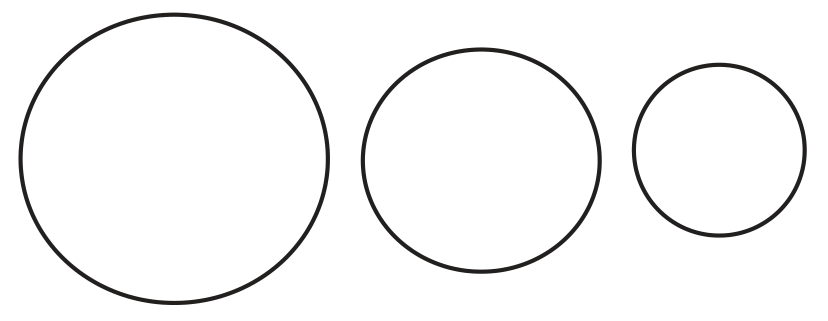
Step: 2:- Wrap all the three sizes with a tissue paper and stick one above the other with glue keeping the biggest at the bottom as shown in the below.
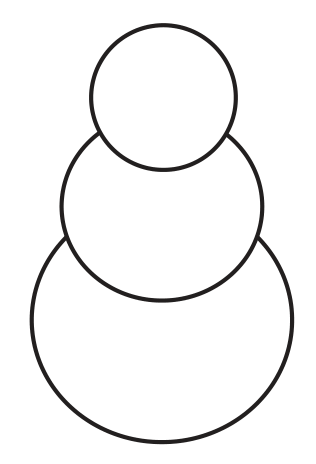
Head
Neck
Wrapped tissue paper
Body
Step: 3:- Take the red color paper and cut out 2 small circles for eyes and long strip for muffler.

Step: 4:- Stick the eye on the small circle and the strip around the neck like a muffler. Take cotton and stick all over the body of the snow man.
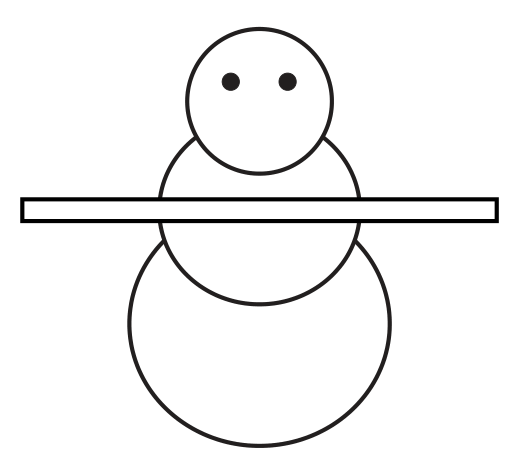
Then the snow man is ready. necessary material on the table. Place a drinking glass filled with water. Add two drops of oil to the water with eye dropper. Observe the oil in the glass floats on the water. Explain the children how oil floats in the water. Floating of egg: Take a cup of water half filled and lower the boiled egg in to it. Start adding salt to the water. Slowly the egg will start floating. First the egg will sink because the density of boiled egg was high. But after adding salt to the water the density of water increased and became greater than boiled egg and made egg float.
Assessment: • What happens when salt is added? • What change occurs when color is added to the ice cube? • What color is the ice cube now? • How does the ice cube change its color? • What happens when red and blue is mixed?
Variation: Add small plastic toys to be frozen. If a small thread is placed on the ice cube it will stick to it and the kids can lift the ice cube.
Skills developed: Cognitive skills of cause and effect Logical thinking skills Sensory development Color combinations
Visual discrimination.
Conclusion: This activity helps the kids to understand the concepts of water freezing to make ice, and develops their sensory awareness.
Observation: Observe the oil in the glass and egg floating in the water. Before adding salt to water how egg was and after adding salt so water observe the changes occurred.
Reason: Cohesive force between oil molecules attracts each other and density of oil is less than water which made oil to float on water as droplets. Boiled egg sinks before in water because density of egg was higher. Salt increased the density of water made egg float in water.
FLOATING EGG AND OIL
Goals: To help them understand the concept that oil and water do not mix because of the cohesive force between oil molecule pull them together and water molecules don't attract oil. And understand the concept about density of water increasing when salt is added.
Vocabulary: Attraction, force, polar molecule, non polar molecules, density, floats etc.
Material required: Boiled egg, two cups, water, eye dropper, salt, 2 spoons of cooking oil.
Introduction and Presentation: Floating of oil: Place
Assessment: • Why is oil floating in water? • Why boiled egg sinks before in water? • What happened to the water after adding salt? • What is the shape of oil dropper? • How does egg float now?
Skills developed: Visual skills Cause and effect Logical thinking Language skills of expressive and receptive
Conclusion: Conclude by giving explanation about density of substance.
DAY 2 : GYM
FREEZE DANCE
Goal: To develop their direction skills, gross motor skills and social skills, auditory skills
Presentation: Children are encouraged to stand in a circle. They are asked to do body movements for action rhymes or for the music or to the instructions e.g. freeze to your right, freeze to your left. They hear the word freeze being told by the mentor. They have to stay still in what position they are. Whoever moves will be out of the circle and say freeze as a catcher. When they hear the word melt they can move.
Skills developed: Develops their direction skills, gross motor skills, social skills, auditory skills.
IN THE POND ON THE BANK
Goals: To develop their gross motor skills and balancing skills, auditory skills.
Presentation: Make children stand in a circle and place hoola hoop in the middle or draw a circle and make them stand around the circle. When we say in the pond all have to jump inside the circle and when we say on the pond all have to jump outside the circle.
Skills developed: develops their gross motor skills, balancing skills, auditory skills.
DAY 3 : ACTIVITY
SORTING BAKED BEANS
Vocabulary: Sort, beans, bake.
Goals: To improve their: Cognitive skills, Pre math skills, Fine motor skills, Eye hand coordination
Material required: Baked beans and plates.
Presentation: Have all the materials ready for the activity. Give each child the materials in a plate. Give each child different types of baked beans and show them how to sort according to their shapes/size/colors. Ask them to feel the different textures.
Assessment: • Ask them to count the beans. • Ask them to name the colors and size of given beans. • Ask them about the texture.
Skills developed: Cognitive skills Pre math skills Fine motor skills Eye hand coordination
Conclusion: By this activity they will be able to understand and classify the objects according to the colors, size, texture, and shape.
STRAW BLOWING LEAVES, FEATHERS
Goals: To improve their oral motor skill, language skill, cause and effect.
Vocabulary - Blow, straw, leaves, feathers, air.
Material required: Straws, feathers, leaves.
Presentation: Make each child sit at the table. To present the activity, take straw and put some feathers or leaves on the table. Holding one end of the straw to your mouth and the other end above the leaves or feathers, start blowing through the hole. Then demonstrate how when you blow the feathers or leaves they will move. Ask each child to blow into a straw or a whistle. What happens when they blow? Give some heavy objects and ask them to blow it.
Assessment: • When we blow what comes out? • What happens when we blow the feathers or leaves with straw? • What helps the leaves of trees or plants to move? • Can we move heavy objects by blowing? • What happens when you blow a whistle?
Variation: Then can even blow water, beads, wooden chips etc.
Evaluation: Evaluate each child's ability to blow with straw or whistle. Evaluate their oral motor skill, their concentration on the activity, their understanding of cause and effect.
Conclusion: This helps them understand the effects of air pressure and improves their oral motor skills and their
DAY 3 : GYM
GATHERING BALLS
Goal: To develop their eye hand coordination, coordination in changing from one position to another.
Presentation: Draw two circles or keep two hoops away from each other. Place more balls in one circle and keep the other circle empty. Each child has to gather the balls fast from one circle to another (carrying only one ball at a time) within a given time.
Skills developed: Eye hand coordination. Gross motor skills. Fine motor skills. Persistence in accomplishing a task. Pre math skills of estimating. Coordination involved in changing from one position to another.
Variation: They can play gathering game with balloons, stuff animal toys, vegetables depending upon the theme.
COPY CAT
Presentation: In this game select one child to be the leader. The other children stand facing the leader and copy the movements the leader does. In this the children learn to do different actions or movements.
Skills developed: Visual discrimination, gross motor skills.
Variation: Monkey see, monkey do.
DAY 4 : ART
CUT AND STICK UMBRELLA
Material required: Color papers with outline (different colors), glue, plain sheet, and safety scissors.
Procedure: Provide each child a set of color paper to cut on the outline (as shown in figure) of different colors, using safety scissors and ask the children to stick it in sequence using glue. Show them the model to get an idea.
Skills developed: Fine motor skills, eye hand coordination.
THREAD PAINTING
Material required: Thread of varying length, different poster colors, uncolored art sheet or plain sheet.
Procedure: Children can dip the thread in the paint and keep it on the art sheet and fold the art sheet holding firmly on the table with one hand and pull the thread out after moving the thread in various directions with the other hand.
Skills developed: Develops their fine motor skills of tripod grasp, eye hand coordination, cognitive skills of cause and effect.
DAY 4 : ACTIVITY
KOLAM WRITING
Goals: To improve their fine motor skills, eye hand coordination, pre writing skills, creativity.
Vocabulary: Kolam, designs, patterns, math, fine motor, gross motor, pre-writing
Material required: Kolam powder (rice flour), samples of some designs, pictures.
Introduction and presentation: You present the activity by drawing few strokes, designs, writing few alphabets and ask the kids to write and draw designs, make dots, patterns, alphabets, numbers, and pictures of their choice. Ask them to write their names, friends name, parent's name, school name.
Assessment: • What are the body parts we use for writing? • What are the materials we use for writing? • Which is your favorite writing tool? • Can they write without using their thumb?
Closing: Talk about the designs, patterns which the kids draw, write.
Evaluation: Evaluate each child's ability to draw, their coordination involved in writing, their creativity, their language skills, to explain what they drew.
Variation: They can write with rava. Give them pattern and then ask them to follow, make maze paths to follow. Add some small stones so they can make a pattern of dots and stones. Add food color to get color pattern.
MAKES HOLES USING TWIGS ON LEAVES
Goals: To improve their Fine motor skills, Pre math skills of arranging and counting, Cognitive skills of exploring cause and effect, Sensory awareness skills (tactile).
Vocabulary: Twigs, Small, Long, Thin, Dry, Wet
Material required: Dried thin twigs, leaves
Preparation: Before starting the activity keep twigs and leaves ready.
Presentation: Show them how to make holes on the leaves using twigs. Tell them to hole the twigs in one hand, the leaves in another hand and encourage them to put hole on the leaves by using twigs.
Assessment: • What is the color of the twig? • What is the color of the leaves? • Can you break a wet twig? Why only dried twig? • How many holes do you made on the leaves using twigs? • What is the texture of the twig?
Evaluation: Evaluate child's ability to count, their eye hand coordination, language skills, concentration and
DAY 4 : GYM
ANIMAL WALK
Goal: To develop their gross motor skills.
Presentation: Hop:-Children are asked to stand on one foot and move from one place to another by hopping. Crawl: - Children are asked to sit on their knee and to move using hands and knee. Creep: - Children are asked to lie down on the floor, on their tummy and move using hands and leg in lying position (like snake). Swim: Children are asked to lie on their tummy on the floor and they are asked to move their hands and legs and do swimming action.
Skills developed: Develops their gross motor skills.
ANIMAL CHARADES
Goal: To develop their auditory skills, observing skills, cognitive skills, thinking and memory skills.
Presentation: Divide the children in to two groups A and B. One child from group A will makes an animal sound, roaring or barking or meowing etc. Team B children has to name animal which makes that sound. Then a child from group B will come and make an animal sound. Group A children has to identify it correctly.
Skills developed: Auditory skills. Observing skills. Cognitive skills. Thinking and memory skills.
DAY 5 : ART
VEGETABLE PRINTING
Goal : To develop their creativity, fine motor skills, cognitive skills of understanding and exploring cause and effect.
Material required: Any vegetable which can be cut in to shapes (e.g. carrot, potatoes, onion, ladys' finger, radish etc), poster colors, paint brushes, uncolored art sheet.
Introduction and presentation : Motivate children to sit and present them the ways they can do vegetable printing. Give them the vegetable which is cut in to different shapes or patterns ask them use paint brush to apply paint on vegetable or dip it in the paint. Ask the children to make impressions or print on the art sheet.
Skills developed: Develops their creativity, fine motor skills, tactile skills, cognitive skills of understanding cause and effect.
SPRAY PAINTING
Goals: To develop their creativity, fine motor skills, tactile skill, cognitive skills of understanding and exploring cause and effect.
Material required: Uncolored art sheet, tooth brush, different colored poster colors, combs.
Introduction and presentation: Encourage children to sit for the art and explain them the ways they can try out different types of spray painting. Ask the children to take one tooth brush each and to dip it in to their favorite color. Ask them to place the tooth brush bristles pointed down towards paper. Guide children to use their thumb finger to move the bristles of tooth brush or they can move the tooth brush on the comb. When they move the bristles of the tooth brush, the paint is sprayed on the art sheet.
Skills developed: Develops their creativity, fine motor skills, tactile skills, cognitive skills of understanding cause and effect.
DAY 5 : ACTIVITY
HOT AND COLD
Goals: Familiarize them to identify the materials with different temperature and moisture levels.
Vocabulary: Hot, Cold, Warm, Wet, Dry, Moisture, Sunny, winter
Material required: Hot water bag, Ice pack, Thermal tablets.
Presentation: Thermal sense can be felt by kids by touching the thermal tablets, hot water bags, Ice pack.
Assessment: • What happens when we touch something very hot? • What happens when we touch something very cold? • Which is the coldest place on earth? • Which is the hottest place on earth? • What is the difference between hot and warm? • Name the materials which are cold? • Which is the item in the house which keeps materials cold? • Which is the item used to cook and warm food? • How do we feel on a sunny day? • How do we feel on a winter day? • What dress do we wear on a sunny day? • What type of dress we wear on winter days? • Name the thing in the sky which is hot? • When do we call an object is wet? • When can we call an object is dry? • How can we make something wet to dry?
Evaluation: First ask them to do with their eyes open, and then with eyes closed. Note down the results. Reinforce the thermal sense when they have their lunch and snacks. Pre-math skills, Comparing, Tactile discrimination, Language skills
Conclusion: Analyze whether they can identify various objects tested on the thermal and moisture level correctly
PEELING PEAS OR DOUBLE BEANS
Goals: To improve their pincer grasp, intrinsic muscle control, eye-hand coordination, sensory skills
Vocabulary: Peeling, peas, double beans.
Material required: Peas, plate.
Introduction and presentation: Demonstrate how to peel the peas or double beans using their thumb and index finger. Demonstrate them how to remove the seeds from the peas or double beans.
Encourage them to do peel the peas or double beans and remove the seeds from it.
Assessment: • What is the color of peas or double beans? • Can you peel the peas without using your thumb finger? • What is the color of seeds? • How many seeds are there in beans?
Evaluation: Evaluate each child's ability to peel peas or double beans.
Skills developed: Pincer grasp, eye hand coordination, tactile skill and sensory skill.
Variation: They can peel cotton, hay straw, banana, orange, smash tomatoes, banana, grapes etc
DAY 5 : GYM
STRIDE WALK
Goal: To develop their gross motor skills, balancing.
Presentation: Child has to keep their leg apart and walk this is called stride walking. We can ask them to do normal walking and stride walking alternatively as a variation.
Skills developed: Gross motor skills. Balance.
BLOW AND CATCH BUBBLES
Goal: To develop their oral motor skills and eye hand coordination skills.
Presentation: Children are asked to blow bubbles or feathers. They can be asked to catch the bubble or feathers which flies higher. We can discuss about how it flies higher, shape of the bubbles, what is inside the bubbles to the children.
Skills developed: Oral motor skills. Eye and hand coordination while catching the bubble or feather.