YOGA POSTPONED
This text was machine-transcribed from the printed book and may contain errors. Select the words and choose “Report a mistake”.
‘Our mind is our major dilemma.’
Nithyananda
MIND: MAJOR DILEMMA.
The presence of our mind is the major obstacle in our path of yoga. We allow the mind to enjoy far too much power. As long as the mind is allowed this power, it is our Master and we remain the servant. As long as this situation remains, so does the confusion and dilemma in our lives.
A SMALL STORY.
A young American man was visiting London and was traveling in a train. Sitting beside him in the train was an elderly British couple. The British lady had a pet dog with her, which she was carrying on her lap. All of a sudden, the pet dog jumped from her lap onto the lap of the American guy and vomited on him. The elderly lady, instead of apologizing to the American became anxious about her dog. She started patting the dog saying, 'Oh, what is wrong with you? Your stomach must be upset.' The young American chose to stay silent.
A few minutes later, the dog again jumped onto the American's lap and urinated on him. Again, the elderly lady, instead of apologizing to the American about this incident, just started patting the dog profusely, expressing concern regarding the dog's health. 'I must take you to the vet! I don't know what has happened to you!' She completely ignored the young man and was not at all concerned about the inconvenience that was being caused by her dog.
After sometime, again the dog jumped on to the American's lap and this time defecated on him. Even still, the British lady did not apologize to the American, however started worrying and fussing over the dog, feeding it food and treats. All the while, the American guy was sitting in silence, watching everything. However, by this third incident, his patience had been tested enough. The American man silently stood up, picked up the dog and threw the dog out of the train window.
After this incident, the husband of the British lady got up out of his seat and shouted at the American guy, 'You Americans are dumb; you drive on the wrong side of the road, use the wrong scale for measurement and now you have thrown the wrong bitch out the window!’
Tʜᴇ sᴛᴏʀʏ ᴏғ ᴏᴜʀ ʟɪᴠᴇs.
The story above, perfectly illustrates our lives. We always throw the wrong things out of the window.
In the above story, the dog was not at fault. The poor animal was obviously sick and was, of course, just an animal with no means of expressing itself. The person who was at fault in this story was the British lady since she was oblivious to the inconvenience caused to another person and not at all apologetic for her dog’s actions. I am not implying that the American should have thrown the British lady out of the window instead. The point I am attempting to make is that the American failed in analyzing the situation thoroughly and made a poor decision by throwing the poor, helpless dog out of the train window.
Similarly, most of our decisions end in dilemma. This dilemma is the term I use to describe our mind. The mind can be defined in countless ways; however, the most appropriate word that can describe our mind is ‘dilemma’. There is no better way of defining it.
When you close your eyes, the mind is whatever you think and whatever you can think, whatever you visualize and whatever you can visualize and finally, whatever you experience and whatever you can experience. This entire whole is what I call the mind.
Vacillating from one extreme to the other is the very nature of our mind. Jumping from one thought to the other is the very nature of our mind. The mind is never convinced or satisfied with its own decisions. Instead it tries to judge and compare its decisions with the past memories. The mind never stays in the current moment. We are in the habit of making too many unconscious decisions and regretting them later. If we can just accept the current moment, existence as it is, we can go beyond the mind. We will experience a state of satori (no mind) which we refer to as enlightenment or super consciousness.
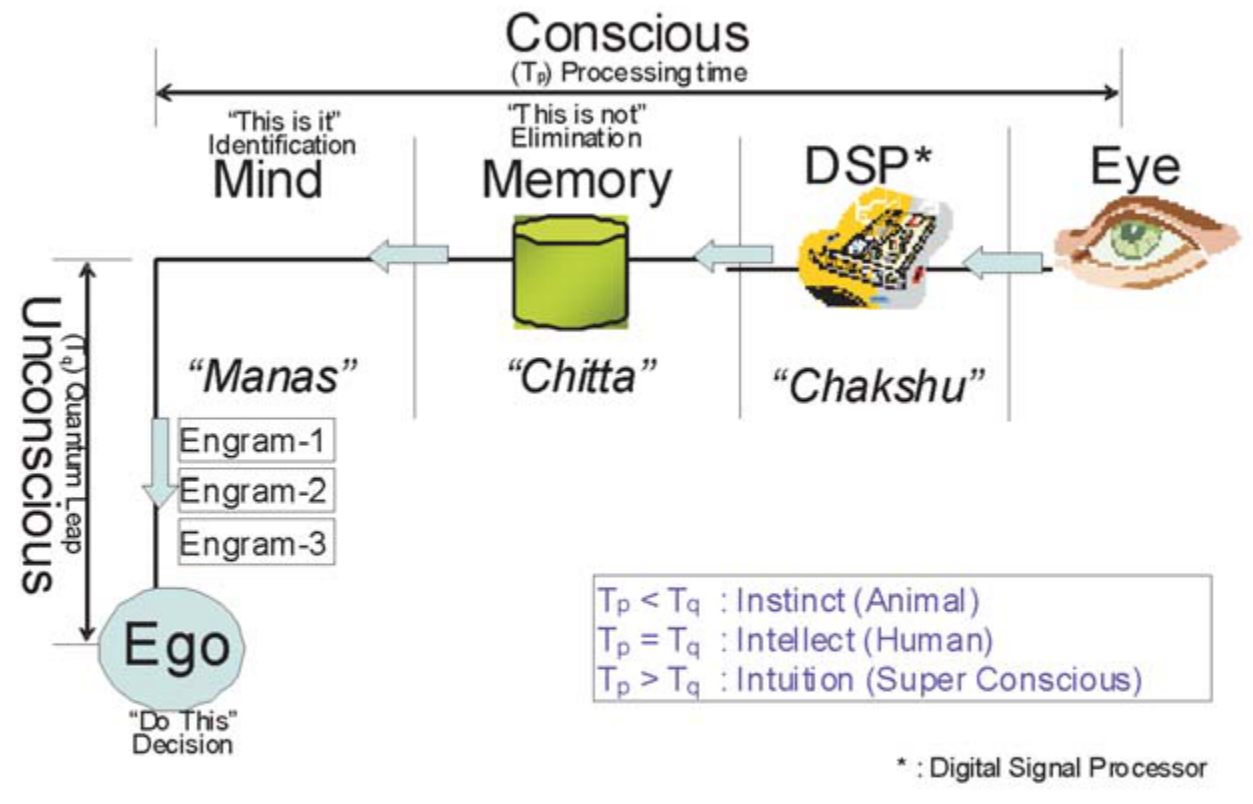
THE WORKING OF OUR MIND. How does the mind actually work? The diagram below illustrates simply how we all perceive things. According to Yoga, this is the way information is processed inside of our system.
CHAKSHU
CHAKSHU
Firstly, when we see something through our eyes, the information that is received through our eyes is digitized by what is known in Sanskrit as chakshu. This chakshu is like a digital signal processor (DSP). The information which is received through the eyes is digitized in the chakshu and it is converted into a digital file.
Let us case of all of you listening to me speaking to you now. What the chakshu captures is my images that it passes on as a digital file.
CHITTA
Next, the digitized file goes to memory which is known in Sanskrit as chitta. In chitta, the elimination process takes place; exclusion occurs. For example, if you are seeing me (Nithyananda), the image seen through the eyes goes directly to chakshu. In chakshu the whole signal is digitized, and then the file goes to chitta (memory) whereby memory starts to analyze the information it has received. It determines that this is not an animal, this is not a plant, this is not a tree, this is not a mountain. This elimination is done by the chakshu. Then the memory function determines that 'this is not, this is not, this is not'.
MANAS
In the third step, the whole file goes to the mind. In Sanskrit, mind is translated as manas. The mind's role is to identify. So all of a sudden, one will identify that they are seeing a Master or a meditation teacher. The mind will identify and conclude that 'this is it, this is it, this is it.'
EGO
Finally, the file will take a quantum leap to the ego. Here it is decided what benefit, if any, the information received (for this example; the Master or meditation teacher) will have for the individual. Once the mind has concluded that the Master or a meditation teacher is being seen, the ego will step in and, depending on one's past experiences with Masters or meditation teachers, it will determine whether or not the viewer will continue to sit and participate.
If someone previously has had a good experience with a Master or meditation teacher, then the ego will identify that there will be something of value. We may decide that this is a good place and decide to continue and sit. On the other hand, if we have previously had a bad experience with a Master or a meditation teacher then we might decide that 'this is not for me and I don't want to continue to sit here.' The ego gives this command to the mind and the command is executed.
To clarify the process:
- EYE – Seeing the Master/meditation teacher.
- DIGITAL SIGNAL PROCESSOR (DSP) - The eye passes the information to the digital signal processor.
- MEMORY - The DSP passes the information to the memory which does the job of eliminating unwanted information.
- MIND - Then the memory passes this reduced information to the mind which does the job of the identification.
- EGO - Finally the whole file takes a quantum leap to the ego, which makes the decision based on our past experiences.
WHERE THE MIND GOES WRONG.
The time for processing between the EYE and the MIND can be called 'Tp' (processing time). This processing time between the eye and the mind is logical and conscious. It happens with our complete awareness.
The time for the processing during the quantum leap from the MIND to the EGO can be called 'Tq' (quantum time). This processing time between the mind and the ego is mostly unconscious. It is an unconscious process for us. It happens without our awareness. During this time we decide quickly and illogically based on past experiences and it usually results in poor, rash decisions which is usually followed with regret.
For example, let's takes the habit of smoking. Logically, people who smoke regularly know that smoking is injurious to the body and mind. When we are in the Tp level, we make this conclusion because the process between the EYE and the MIND is totally conscious and logical (the conscious zone). At this level, smokers understand logically that smoking is bad.
However, in the Tq level, which can be referred to as the unconscious zone, the quantum leap from the MIND to the EGO occurs and this process is unconscious. This process happens without our awareness. During this time, illogical decisions occur. Although we can logically conclude that smoking can have detrimental effects on our health, people addicted to smoking, again and again continue to make the decision to smoke.
This person came and saw me one time. He told me that he had recently read a book about the negative effects that smoking had on our Being. He said, 'After that I stopped.' I told him, 'Oh that is nice. You have decided to stop smoking.'
He said, 'No Master, I decided to stop reading such confusing books.'
Many times, we know what is right and what is wrong, however, we are not able to decide with our straight, logical data. However, if we made decisions based on our logic, then our entire life would be conscious. So, what causes us to decide illogically and irrationally? Why is it so common for us to make such bad decisions that ultimately result in regret and dilemma?
DEEPLY ENGRAVED MEMORIES. The reason for making poor and illogical decisions over and over again rests in our Tp level. It is because our Tp level, or the unconscious zone, is filled with negative memories. These negative memories tend to be deeply engraved in our Being and are defined in the field of psychology as engrams. In Sanskrit, these engrams are referred to as samskara. Samskara are stored in the unconscious zone.
So, while logically we know that smoking can be damaging to our health, we might continue to smoke because of the deeply engraved memories. The memory or habit of smoking is inscribed in our system. Samskara are so powerful that they will cause us to act in the same way again and again.
Samskara have tremendous force and power over our Being. They more or less control our lives. All of our hasty and often harmful decisions are made as a result of these samskara. Samskara are the root cause for stress and also responsible for all psychosomatic illnesses.
I have at least 600 American doctors initiated to provide Ananda healing. And our latest count shows there are over 5000 healers worldwide serving society through 800 healing centers. On average, our records show us that 50,000 people are touched by our healers everyday around the globe. I can tell you, from my experience, that many of the psychosomatic illnesses reported have taken root as the result of samskara. Fortunately, it is possible to abolish these samskara through meditation. If people would eliminate their samskara through meditation, this would be a huge service to humanity.
The more samskara we have, the more the fight. The more samskara we have existing within, the more stress that manifests in our life. The more samskara we have, the more difficult it is to move in life. Whether it is in relationships or has to do with our profession, it will prove extremely difficult to make any decision. Even small decisions look too big! The more samskara, the longer it will take to make any choice. That is why many times we are not able to decide about something for 10 years. By the time people decide whether or not to get married life is over. Many times we can't decide because there are too many engrams.
Our entire ability to move in life is completely disturbed as a result of our engraved memories.
INSTINCT, INTELLECT AND INTUITION: ANIMAL, MAN AND GOD.
Humans normally operate on 3 levels: instinct, intellect and intuition. The relative length of time it takes for the conscious process to happen versus the time it takes for the unconscious process to happen, determines whether we are operating on the level of instinct, intellect or intuition.
The first level of operation, or processing is referred to as instinct. This is the very basic level, where we exhibit animal instincts. On seeing a sweet in front of us, we pounce on it, just as an animal would pounce. Similarly, the habit of smoking is also an instinct.
The second level is the intellect level, where we choose our responses intellectually. The moment we start choosing intellectually, we give power to our mind. Our habit of choosing usually stems from greed or fear. Greed motivates us to choose and fear motivates us to escape from certain things. On seeing a sweet, we start analyzing whether we should have it or not. If we already have a full stomach our level of greed determines whether we will choose to eat the sweet or not. Or if we have diabetes, our fear of aggravating the condition will determine whether we eat the sweet or not. Ultimately, if we choose intellectually, it will only end in worry, confusion and dilemma.
Not choosing and just accepting the flow is what I call intelligence. Simply going with the flow. When we understand and accept the will of Parasakti (which is the universal cosmic/primal energy or supreme power), we also enter into the higher level of intuition. At this level, the divine energy starts flowing through our Being. We become an instrument of the divine cosmic law. When we continuously operate in this level, we reach the state of enlightenment. We become God.
Intuition is a very difficult word for logical people to understand. It is hard for logical people to believe that something called intuition actually exists. To most of us, we consider intuitive people as somewhat special, blessed or gifted individuals. When any of us have ever had an intuitive moment, we normally brush it off as being a mere coincidence.
I have often heard people use these terms interchangeably, without seeming to understand the difference. They say, my intuition told me to do that, whereas what they actually mean is instinct. Instinct is driven by the reptilian brain that stores all the memories of our evolution. This is part of the unconscious part of our brain. This part of the brain operates and decides at lightning speed.
It has been established that the unconscious brain can process around 60 million bytes of information per second if needed whereas during the same period the conscious part of the brain can only process 60! So, when it comes to who decides, the conscious brain does not sand a chance!
Instinct and intuition operate at opposite ends of the spectrum. Instinct operates from the unconscious brain whereas intuition operates from the super conscious brain.
Have you ever been sitting at a party when you suddenly get the feeling that within five minutes, somebody is going to arrive or something is going to happen? After sometime this person arrives or the thing that you thought was going to happen actually happens. Or, has the telephone started ringing in your house and suddenly you remember a friend that you have not seen in 10 years. You pick up the phone and this friend is there on the line. Or, has the doorbell sounded and suddenly you remember some relative's name? You go and answer the door and who is standing there? That relative.
Sometimes people tell me that they have gone to visit a friend's house for the first time. They tell me that they felt as if they had been there before. They suddenly are able to identify, even before seeing, items that are there in other rooms. Whenever I hold discourses relating to this subject of intuition, I always ask the gathering if they have at least once in their lives, had any experiences such as these. In any gathering, always more than 80% of people raise their hands.
If these moments of intuition had only happened in one individual's life, maybe once or twice, we could easily reject the idea of intuition and call it as a mere 'coincidence.' However, when it obviously occurs in the lives of so many individuals, it is something more than coincidence. Research is always being done to try and explain the phenomenon of intuition. This can be explained in accordance with yoga.
At the moment of intuition, knowingly or unknowingly, we come to the present moment. When we come to the present moment, we have the power and the energy to see what will happen next. There is almost no confusion. The file reaches our EGO without the influence of any samskara that are sitting there in our unconscious zone.
The whole process is totally conscious. That is why we suddenly get a glimpse of intuition. And, I tell you, it is possible to stay continuously in that same state of practice.
Einstein said, 'Logic is a servant and intuition is a gift from a higher energy.' I don't agree. If it is a gift, we will have to wait. Who will give the gift? When will they give the gift? What time? Will it come or not!?
Intuition is not a gift. We can actually make it like a salary. We can work for it. We can achieve it. We can make it a part of our lives. We can eventually stay in a permanent state of intuition. Intuition is a side effect of the elimination of the negative memories (samskara) that are stored in the unconscious zone.
The dilemma in our lives is caused by these samskara stored in our minds. These samskara are the cause for our bad decision making, our bad habits, our physical and mental disease, our poor intuition and our overall lack of well being and peace. The way to change our lives from dilemma to divine is through the removal of these samskara. What is the prescribed technique recommended for the removal of samskara?