Unclutching In Depth
This text was machine-transcribed from the printed book and may contain errors. Select the words and choose “Report a mistake”.
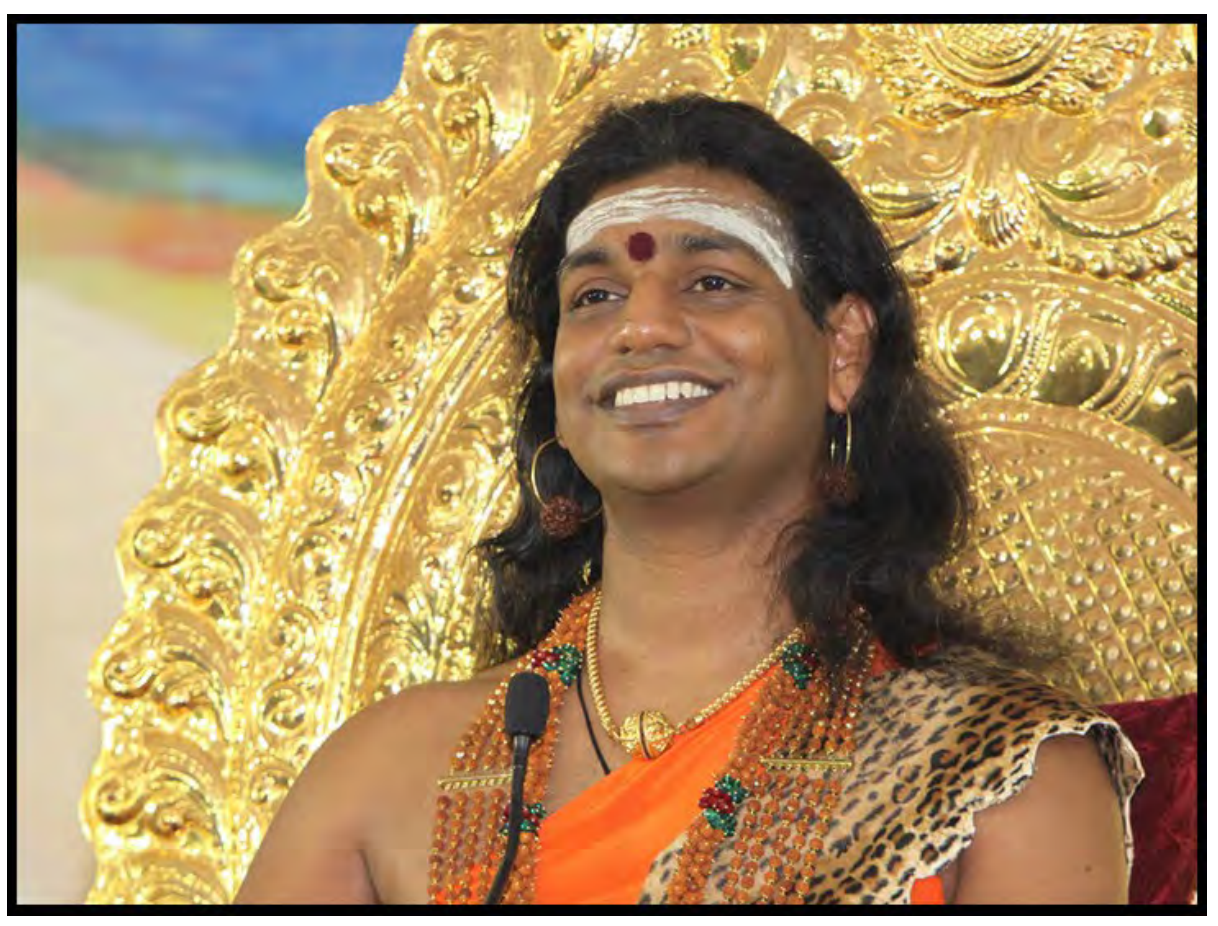
Unclutching is a beautiful spiritual technique which enhances our inner balance and leads us ultimately to a state of eternal bliss. Here is Paramahamsa Nithyananda's explanation of what is meant by the word 'unclutch' and how the concept operates.
The mind is nothing but a collection of consecutive thoughts. One thought follows another in swift succession, but by their very nature, they are unconnected. Thoughts are like bubbles in a fish tank. The bubbles in the fish tank are not connected. They are distinctly separate, but because they emerge in a rapid stream, they appear to be joined.
In a similar manner, our many thoughts are not connected to each other, but because of their rapidity it seems that they must be following each other logically. We can do a small exercise to test this. We can write down all our thoughts as they occur.
Sit for ten minutes in silence and record your thoughts. Do not try to control them or stop thinking, just witness each thought as it arises and jot it down. Do this for ten minutes.
At the end of ten minutes, read out whatever is written. You will see that it is a mad man's diary! There is utter chaos. There is no connection between one thought and the next thought. All the thoughts are unclutched and disconnected. It is easiest to see this when we write them down; we will come to see that our thoughts have no connection.
We may be thinking about having a cup of coffee. The next moment we may think about some office work, which is pending. There is no real connection between having a cup of coffee and the office work; both are independent events. Even if we have two consecutive thoughts about the same event, the thoughts themselves are discrete from each other since there is no continuity.
There is always a gap between thoughts, although it is difficult to see without practice. There is a time of silence between thoughts. The thoughts by their very nature are unclutched, meaning independent.
Imaginary Shaft
It is when we connect these thoughts that we develop confusion. We create suffering for ourselves by connecting these unconnected thoughts. For example: we might have eaten ice cream ten years ago, we might have eaten ice cream seven years ago, we might have eaten ice cream two years ago and we might have eaten ice cream yesterday.
Each of these experiences might have been very pleasurable. We might have enjoyed the ice cream each time we ate it. But when we connect these experiences, when we believe they are related to each other, we create an imaginary shaft, an understanding that eating ice cream makes us happy. Then we try to repeat this experience as often as we can, under the belief that eating ice cream can give us happiness.
When we connect similar thoughts, we create a shaft. It might be our actual physical experience that sometimes we do not enjoy the ice cream as much as we enjoyed it in the past. But even if we do not enjoy it now, we cling to the belief that it can make us happy. Because we have gotten into the habit of connecting our thoughts, we unconsciously accept that we always enjoy ice cream and that it has the power to make us happy.
The situation is similar for painful experiences. The pain we experienced ten years ago, the pain we experienced seven years ago, the pain we experienced three years ago and the pain we experienced yesterday are independent events. There is no connection between these events. But if we feel our lives are often painful, and if we highlight the painful events so that they stand out in our attention, we are likely to create an imaginary shaft and tell ourselves, ‘My life is always a pain’.
If we have had many pleasurable experiences in life we may say, ‘My life is a pleasure’; but actually neither of these statements is true. Life is neither a pleasure nor a pain because the very process of connecting these events is a mistake. The idea that our thoughts are connected is a misconception.
Furthermore, we do not connect all our thoughts. We connect only those thoughts that we remember, just as from a bunch of flowers you pick up a few flowers and create a garland, from the millions of thoughts we have, we connect a few thoughts that we remember and create a shaft. Creation of the shaft is the original sin. When we create the shaft, we suffer. If we have created a shaft of pleasure, we will try to extend the shaft because we want to experience the same pleasure again. If we have created a shaft of pain, we try to break the shaft because we want to avoid the pain. In reality, we can neither extend nor break the shaft, because it does not exist! The shaft itself is a myth. The creation of the shaft has become one more shaft for us.
You Are Already A Buddha!
All our experiences are independent experiences. The moment we connect these experiences we create hell for ourselves – we create suffering. With this perspective, it becomes easier to understand why spiritual teachings insist that suffering is imaginary. It is based on something imaginary. It is based on something non-existent. It is just an appearance. The shaft is unreal; it does not exist. So the suffering that is created due to the shaft is also unreal. Once we realize this, we are liberated.
Because our thoughts are very powerful, they have the capacity to clutch other thoughts and create an imaginary shaft. This process of creating the imaginary shaft is the function of the ego. Ego is not a separate entity from our thoughts; it is actually characterized by our thoughts. Following this reasoning, we can then conclude that the ego does not exist because the shaft does not exist. The shaft is imaginary; and ego is just a name we give to the process of creating a shaft.
A sense of continuity is created because of the shaft. Our lives seem to flow in an unbroken thread and to hold together with a consistent purpose. This gives us the illusion of ego.
Since right now all our thoughts clutch, we feel that we have an ego. But all our thoughts by their very nature are independent, so the ego is non-existent as there cannot be anything connecting these thoughts. Thus by our very nature we are unclutched; we are already enlightened. We just need to realize it.
Once a disciple went to a Zen master and asked him, 'How can I become Buddha?' The master gave him a tight slap in the face and said, 'You are already a Buddha!'
If Buddha comes and asks you how he should become Buddha, what would be your reaction? Such was the reaction of the Zen master! We are unclutched by our very nature. We just need to wake up and understand it.
We all have the choice to not connect our experiences, to not create imaginary shafts. We become attached to a person, a circumstance or an object because of the shafts we build around them. The relationship we experienced three years ago, the relationship we experienced a year ago and the relationship we are experiencing now are independent events, even when we are relating to the same person in all three events. The moment we connect these events we are trying to either extend or break the shaft. If the relationship is a pleasurable one, we want it to continue to be pleasurable forever. If it is a painful relationship, we try to break the connection or create idea belief for ourselves that the relationship is not good for us.
We do not realize that at each instant we are experiencing a new relationship. Because at every instant two new people are associating and interacting. By our very nature we are unclutched.
Bondage And Liberation
The real problem is not caused because of pleasure or pain. The real problem is caused due to our incorrect understanding of both, which leads to the creation of imaginary shafts. In the case of a sage, if there is pleasure, he will enjoy the pleasure and forget it. If there is pain, he will suffer the pain and forget it. He does not carry these experiences in horizontal time. The moment we carry an experience in horizontal time, we suffer.
We can experience life living in this world and still be centered in peace and harmony. There is no need to renounce anything external. Only the smaller self, the imaginary ego, has to be renounced. Once we cease creating the shaft, we will realize that the identity we were trying to cling to was the very reason for our suffering. The moment we drop that identity, we enter into bliss!
At that point, external incidents will not affect us because we have given up the habit of connecting them. Every incident is a new experience for us. We begin to see life in a much more beautiful way. Everything seems joyful and blissful. We stop taking things for granted.
Once we accept life from moment to moment, bliss just blooms within us. External circumstances can impact us only if we allow them to. No one can disturb us without our silent permission. We may think that if we live our lives in the moment but others around do not, they may exploit us. Be very clear, nobody can exploit us or disturb us without our internal agreement, even if it is unconscious. Once we understand that our true nature is unclutched, we cannot be disrupted by outside influences.
Śaṅkara (a Hindu sage) says in his devotional poem Nirvāṇaśatkam:
Sanskrit:
न चासङ्गतम् न मुक्तिर्नमेयः
चिदानन्द रूपः शिवोहम़् शिवोहम्
Transliteration:
na cāsaṅgataṃ na muktirnameyaḥ
cidānanda rūpaḥ śivoham śivoham
Translation: I am neither in bondage nor liberated, I am always in the state of equilibrium. I am of the nature of pure auspiciousness, the energy of Śiva.
Both bondage and liberation are concepts created by the mind. Liberation exists as long as there is bondage. But if there is no bondage, we are already liberated! That is what Śaṅkara is referring to.
If we are trying to go inward or outward, as long as we are going somewhere we are missing the truth. The very process of traveling or going takes us away from the truth. Truth is here and now. There is no need to go anywhere; no need to travel anywhere. The very act of traveling shows that we have created a shaft; we are seeing some progress. There cannot be any progress, because there is nobody who is progressing! As individuals, we are dying at every moment. What can we possibly progress toward?
When we are unclutched we will automatically explode beyond any imagined limitations. The question of whether we are material or spiritual will not even arise. This is the sacred secret within Śaṅkara's statement, when he says that he is neither in bondage nor liberated. He has gone beyond both. Both are just concepts.
Our 'self' can never be improved. Some people work on self-development. What self will we develop? Is there a self to be developed in the first place? A sequence of unclutched thoughts is the only thing we are. If we try to develop the self, all we end up doing is to create a shaft of the idea that 'my self is developed'. It can give us a good feeling, a sense of accomplishment and pride in our effort. But speaking in reality, the self cannot be developed, it can only be eliminated, because it is imaginary. It does not exist. As long as we are trying to develop the self, we are just creating a shaft.
As long as the mind is present, the identification with the unreal continues. Śaṅkara says: Sanskrit:
ब्रह्म सत्यम् जगत् मित्या
जीवो ब्रह्मैव न अपरः
Transliteration:
brahma satyam jagat mithyā
jīvo brahmaiva na aparaḥ
Translation: Brahman (divine wisdom) is real, the world is unreal and the individual soul is undifferentiated from Brahman
What he is describing is that only when the mind ceases to exist, the Brahman – the soul, the core spirit beyond the mind – shines forth. Reality reveals its unclouded glory.
But as long as there is mind, there are thoughts which pass like clouds to obscure the sun of the divine spirit. Thoughts always hover either in the past or the future. Thoughts are never about the present. In the present, only consciousness exists. As long as thoughts are forming within us, we will continue to create shafts. The moment a shaft has been built, we identify with unreality. The imaginary identity (which Śaṅkara calls jeeva) comes into apparent existence. When the jeeva appears, the world of mithyā (unreality) accompanies it. Once we unclutch, the false identity disappears spontaneously and the Brahman consciousness is revealed.
Two Types Of Identity
We have two types of identity. One is the identity that we show to the outer world. The other is our 'private' identity, our inward self-image. The identity that we show to the outer world is called ahaṅkār. The inward identity is called mamakār. These identities are in constant conflict with each other.
To illustrate, outwardly we may project that we are such-and-such a person. Inwardly we know, however, that we are inadequate for the role we play, in some fashion or other. There is always a discrepancy between these two identities.
The identity we project to the outer world is always bigger than what we actually are; it is inflated to the dimensions we believe we need to measure up to. Most of us try to prove we are superior in front of others; we do our best to 'look good'.
The identity we project to ourselves is always less than what we actually are. Most of us are aware that we are dissatisfied with ourselves. We are constantly working on improving some aspect of ourselves. We may feel inadequate spiritually, materially or in some other domain of our being.
This inner identity, mamakār, always lacks something in our eyes, and the outer identity, ahaṅkār, always exceeds the external reality. Hence these identities are in conflict.
That is why we have to be very careful when we speak, because we rarely say what we honestly think. If we start directly reproducing our thoughts into words, people will run away from us! Rāmakṛṣṇa Paramahamsa, an enlightened spiritual master from Bengal, taught that aligning our thoughts and words in harmony is true spirituality. Alignment occurs spontaneously when we move beyond the ahaṅkār-mamakār conflict.
Both our identities are false. They result from the shaft we create. They do not exist in reality. As long as we associate with these identities we are caught up in saṁsāra, the chase for fulfillment from external stimuli. Once we step beyond the false identity game, we graduate into enlightenment.
Until then, we are occupied by the unending process of creating, sustaining and destroying thoughts. The process of creation (Brahma, the Hindu deity for creation), sustenance (Viṣṇu, Vishnu, the Hindu deity for maintaining what has been created) and destruction (Mahadeva, or Śiva, the Hindu deity for recycling whatever is no longer useful) flows in a continuous stream both around us and within us. When we are able to cease creating, sustaining and destroying, we rise beyond the wheel of saṁsāra and reach the state of Parabrahman (our true, essential being).
Meditation Technique – The Practice Of
Unclutching
All we need to do to prepare is sit 20-30 minutes daily in the space of unclutching. This will automatically cause the number of our thoughts to decrease.
Sit in a quiet meditative mood. Focus, without stress or pressure, on the understanding that your thoughts are unconnected, irrational and unclutched. There is no horizontal connection between your thoughts.
If thoughts arise, neither try to suppress them, nor react to them. Simply observe them with the understanding that they are unclutched. Your witnessing consciousness will spontaneously begin to blossom in you. The more you strengthen this inner witness, the more you will be able to see beyond your two false identities. You will realize that neither the shaft of pleasure nor the shaft of pain is real. You are the background on which these shafts have been drawn.
At first, as with all new practices, thoughts will seem to arise more strongly. Remember that every new skill takes time. We do not give up learning to ride a bicycle the first time we lose our balance; we do not abandon a dance class because we cannot master each step at the first session. Have patience with yourself. You will find that the inner witness of your consciousness is eager for exercise and will come forward swiftly when you engage this practice.
Initially, the spaciousness we create may feel like emptiness, because we are used to so much chaos and crowding from our concerns and troubles. We may feel a little downcast, a little depressed by the new quietude. What has happened is that we have lightened our load, we have set down our internal baggage. Until we adjust to the comparative silence, we may feel temporarily depressed, it does not matter.
Hold the understanding that whether you realize it or not, accept it or not, you are already enlightened. By your very nature you are unclutched. Honor this enlightenment in yourself and experience the unclutched state, the state of pure being and bliss.
This practice is the ultimate technique to experience the state of enlightenment.
If your experience of unclutching practice inspires you, you can advance it by participating in the Inner Awakening Program. This program is designed to awaken the higher frequencies of consciousness in you and establish you in the unclutched state.