106. Look in and renounce
This text was machine-transcribed from the printed book and may contain errors. Select the words and choose “Report a mistake”.
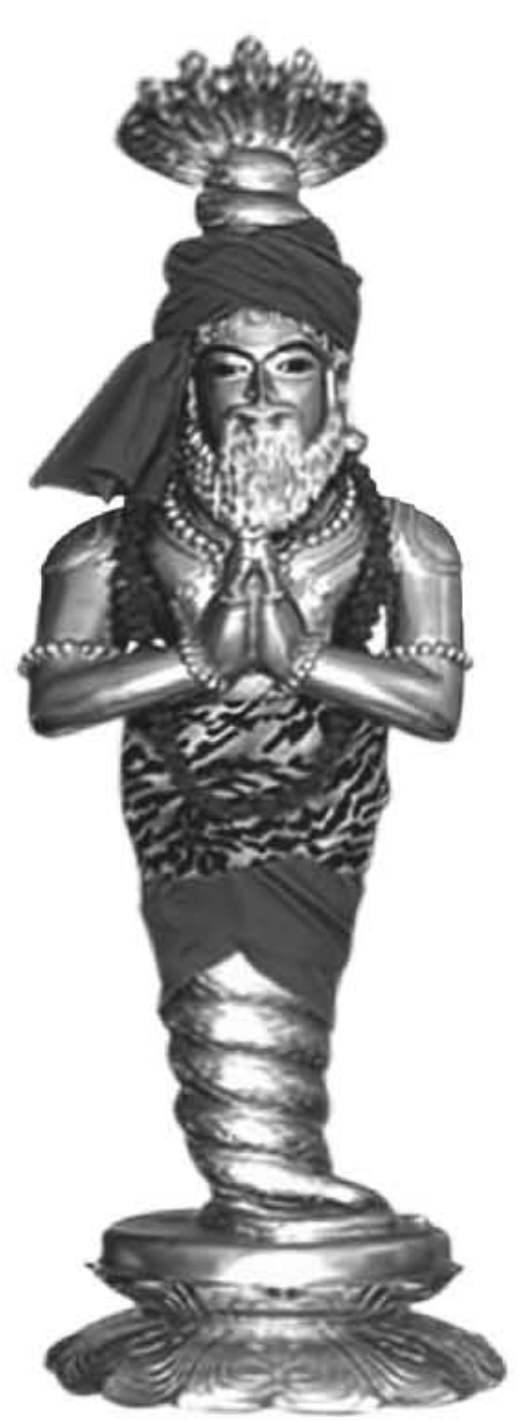
Let us enter in to today's sutra, the 16th sutra. I will read the sutra, then give you the translation, then enter in to the commentary. Tatparaṁ puruṣakhyāterguṇavaitṛṣṇyam
In the last sutra, Patanjali spoke about the renunciation of the outer-world things. In this shloka, Patanjali speaks about the vairagya related to the inner world. He is taking us to the deeper level of vairagya. I can say that the vairagya related to the inner world is more important and needs to be more carefully understood than the vairagya related to the outer world.
Here, Patanjali is giving us a beautiful technique to live vairagya, not just with the outer-world things, even from the inner-world characteristics, the gunas. Gunas are not even characteristics; they are the inner world smells which you experience – dullness, restlessness, inertness or restful awareness. If vairagya happens even with them, enlightenment happens.
I have a story for you: There is a terrible accident at a railway crossing when a train smashes into a car. No one is killed, but the car's driver takes the train company to court. At the trial, the railway engineer insists that he had given the driver ample warning by waving his lantern back and forth for nearly a minute. The court believes his story and the suit is dismissed. 'Congratulations!', says the defense lawyer to the engineer, 'You did superbly under cross-examination.'
'Thanks,' replies the engineer. Then he adds, 'But the prosecuting attorney sure had me worried.' 'How is that?' the lawyer asks. The engineer replies, 'At one point I was afraid he may ask me if the lantern was lit!'
Understand, the biggest accidents in your life happen because the lantern was not lit; the word vairagya was not understood. Even the suffering which comes to you when you are trying to accumulating wealth will disappear when you understand that all you need to do is raise your responsibility, and the wealth will come. There is no need to carry the constant insecurity during the process.
In the same way, in the spiritual life, you don't have to continuously struggle to renounce and choose poverty; you don't need to constantly torture yourself in the name of renunciation. You don't need to on abusing yourself and create guilt if you miss one or two things in renunciation. The suffering in the outer world and the suffering in the inner world both get completely heal with the understanding of this one word vairagya.
> Whoever reads these sutras
> understands them
> according to his
> own level of maturity.
away, or mentally they are shut. Patanjali gives us a universal solution. Understanding of this one word can create the cognitive shift in us, in the way in which we observe things, the way in which we think, the way in which we express ourselves.
What is meant by 'transcending attachment'? Listen: at the age of five, you used to play with your toys, and you felt those toys were your life. If someone took those toys away from you, you felt as if your life was being taken away! As you grow up, you come out of that attachment naturally, spontaneously, without any suffering. At the age of 40 or 50, do you feel that you have renounced your childhood toys with great difficulty? Do you have a hangover about your toys? No! You have simply transcended that attachment; you are beyond it, that's all. This is what I call vairagya - just elevating your consciousness to the level where you don't feel either attached to or detached from anything.
Tatparaṁ puruṣakhyāterguṇavaitṛṣṇyam There are many translations of this sutra.
Vivekananda translates this sutra as 'That is extreme non-attachment which gives up even the thirst for the gunas.' He says, even the thirst for these three gunas should be renounced, which can happen only when we understand the supreme self. Sant Jnaneshwar translates this sutra in this way: 'Indifference to the subtlest elements, constituent principles are qualities themselves achieved through knowledge consciousness of nature of pure consciousness is called supreme non-attachment.' We can see how two different masters view this sutra in different ways. Now I will try to give my translation. Tatparaṁ puruṣakhyāterguṇavaitṛṣṇyam Withdrawing from the desires through the conscious visualization of one's inner space is the higher state of awareness.
I can say that the ideas that Patanjali is sharing with us now are the Vedic solution for the economy crisis. If this one concept of vairagya is understood properly, we will neither have the problems created by extreme materialism nor the problems created inside us by these so-called spiritual ideas. This understanding is necessary for the people who live in the world as well as the people who work towards the spiritual enlightenment.
The word vairagya has to be translated as 'transcending attachment', not as 'detachment'. The moment you use the word 'detachment', people are afraid, they don't want to listen to what you are talking! They either walk all the secret spiritual keys in the sutras. So whoever reads them understands them according to his own level of maturity. If an initial-level seeker opens up this book, he will have the inspiration he needs to work on this sutra; is a long-term seeker opens up the book and reads it, he will have the inspiration to go to the next level; if a seeker who is almost done with everything and is on the verge of enlightenment reads it, he will get the last push, the final jump into enlightenment.
The beauty of Sanskrit is that you can get different-different meanings depending on where you break the flow of the words! So you can understand the same sutra in many ways. If you read the whole sutra as a single word, it gives you one meaning. If you break it into smaller words, it gives you a different meaning. If you break the words differently, you get a different meaning. The sutrakaras who write the sutras, they play with language. They have kept
CONTEMPLATION
Vairagya is elevating my consciousness to the level where I don't feel either attached to or detached from anything.