10. Three kinds of Solutions
This text was machine-transcribed from the printed book and may contain errors. Select the words and choose “Report a mistake”.

Let us look again the third sutra: Tadā draṣṭuḥ svarūpe’vasthānam | | 1.3 | | It means, when withdrawal from mental patterns happens, when you take the responsibility for your mind, suddenly you will see that you are able to have your mind under your control. Having that freedom, having that liberation, is what Patanjali calls svarūpe’vasthānam, being established in your own nature.
We need to understand the word ‘nature.’ It is an important understanding. Usually what we call our nature is our usual state, which is confused, deluded and depressed. What we call ‘normal’ is this state! This is because we are using the standard given to us by people like Sigmund Freud, who only worked with mentally ill patients as his specimens - never the beings who live in completion, never with enlightened masters! So we use that standard and think that this is our normal state! No! When Patanjali says svarūpe, ‘in your own nature’, he means - complete, settled, pure Consciousness, which is actually your true nature. When chitta vritti nirodhaha happens, when the state where there are no thoughts happens, that is what is our natural state.
When you look at these sutras superficially, Patanjali looks like a scientist – straight to the point. He is not lost in poetry. For an enlightened master, talking in simple straight prose is very difficult, because in enlightenment, you are lost in ecstasy. You are lost in ecstasy! Talking in plain prose seems abnormal, too rude, too violent. But here, if you look a little deep, you will understand the deep compassion of Patanjali in the very stand he takes. He is not interested in agreeing with what you call as you nature, with what you call as standard. From the very first step, he is very clear about what our nature is.
Through these first three sutras, he is trying to give that straight click to the first 33%- to the people who are waiting for the truth, who are just waiting for the click to happen. He is giving them a chance. So in these three sutras, he gives the essence of whatever he wants to say. All you need to understand is this: you can stop the mind, because it is an action. This one understanding is enough, nothing else is needed. You are a yogi now. You ARE a Yogi. But when you don't understand, you think, 'No, it is not that easy! Yoga cannot be that simple. If it was, why does Swamiji have such a big book in front of him? And why do people study for so many years, so many hours, bending this way, that way, standing upside down and all kinds of things'?
When you have any of these questions, you belong to the second 33%. Now, Patanjali is talking to you. He is taking the next step. He has started using the regular words of a teacher. The first three sutras are spoken like a master, a straight Zen master. Now he is going to the second tone. He starts explaining, one by one. He is using more words. I can say, he is compassionate; he does not want to give up on us. Later in this book, he starts handling the third category. He is slowly touching each category, one by one, with tremendous patience! Actually, when I first read the Yoga Sutras, I thought, 'How can an enlightened master be so dry?', because he is not making any jokes, no stories or poetry. Nothing! He is talking like an angry husband - not a single extra word! Now I understand. First, he is talking to the people who are ready to receive yoga; who are in this moment, who are ready to explode. He can't make them wait. So he straightaway delivers the truth to them. Once he is finished with them, he goes to the second 33%, and here he is a little more relaxed. He is using extra words, because they need to be convinced. And when he is touching the third 33%, you will see he is very poetic, very tempting - using all possible words, methods, techniques to give extraordinary powers — giving all possible bonuses. He has all kinds of big sale boards when he is working with the third 33%. Patanjali is not ready to give up on a single seeker — that is his greatness.
> The state where
> no thoughts happen
> is our natural state!
CONTEMPLATION
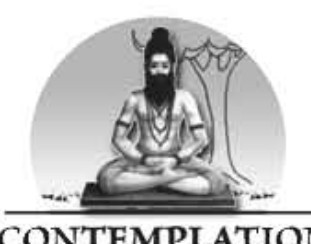
Today, contemplate again and again on this: What is my true nature, which has been described as 'limitlessness and total understanding'?